
UK Greyhound Racing Tips & Expert Betting Strategy
How to read form, pick winners and build a strategy for betting on the dogs.
Best Greyhound Betting Sites – Bet on Greyhounds in 2026
 Available in US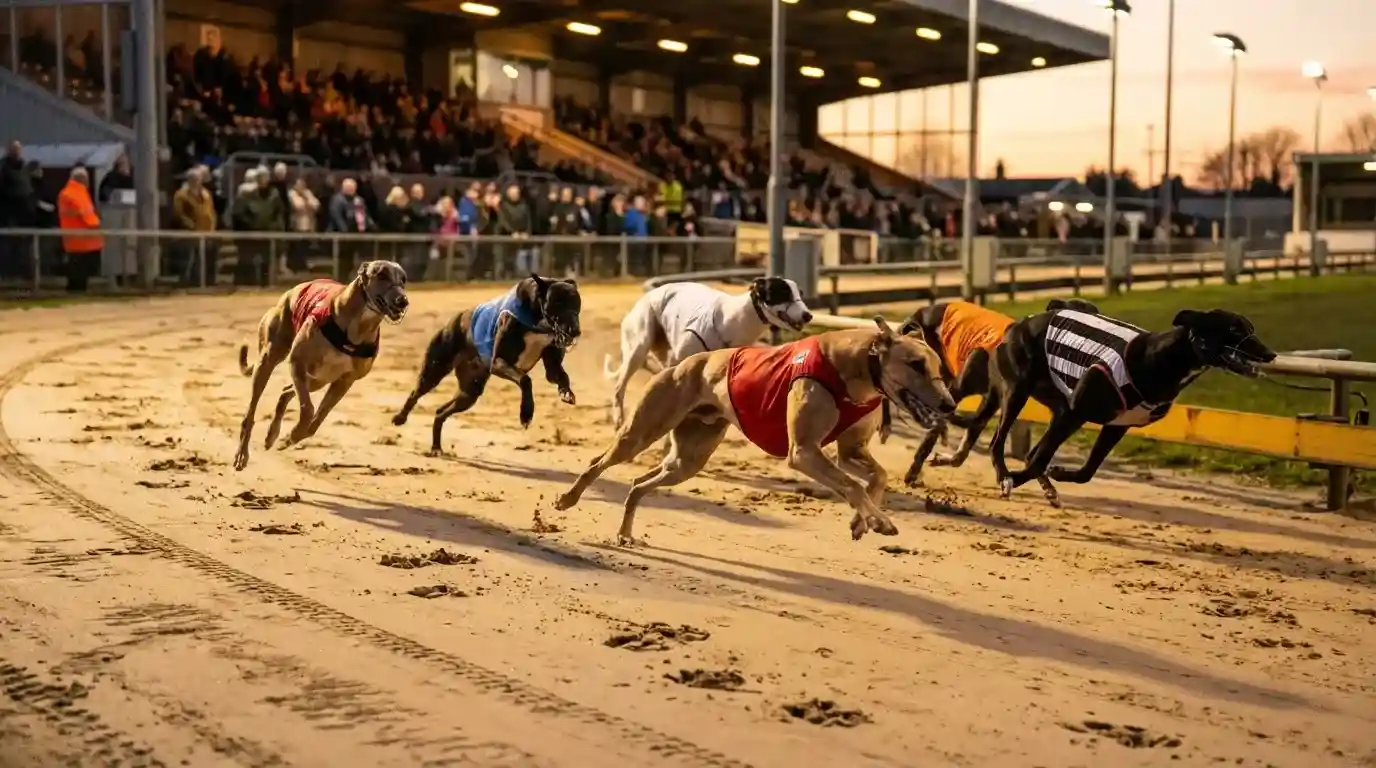
The Six Trap Game: Unique Greyhound Betting Factors
Six dogs, one hare, and thirty seconds of controlled mayhem — that's the pitch. Greyhound racing runs 365 nights a year across 18 licensed UK tracks, with six dogs chasing a mechanical lure over sand at speeds past 40 mph. Every single race is a betting event. Unlike horse racing, there is no jockey to blame, no going stick to consult, and no draw bias that stays neatly consistent from one venue to the next. This guide breaks down exactly how to turn that apparent chaos into a genuine edge.
The small field is the first thing newcomers notice, and it creates an illusion of simplicity. Six runners. Pick one. How hard can it be? Harder than it looks. A six-dog field means every runner has a roughly 16.7% statistical chance of winning before you factor in form, fitness, trap draw, running style and track conditions. That baseline probability is far higher than horse racing's typical 10-to-20 runner fields, which is precisely why greyhound markets are thinner, less liquid, and — crucially — more prone to pricing errors by bookmakers.
Key fact: All greyhound races sanctioned by the Greyhound Board of Great Britain feature exactly six runners. Eight-dog races were phased out on safety grounds, and the standard field size has been locked at six across every GBGB-registered track.
Racing takes place morning, afternoon and evening. Morning and afternoon cards are typically BAGS meetings — Bookmakers' Afternoon Greyhound Service — broadcast into betting shops and streamed by online bookmakers. Evening cards, often televised on Racing Post Greyhound TV, tend to feature stronger fields and open-race competition. On any given day, there can be upwards of 80 individual races across UK tracks. That volume is both an opportunity and a trap: enough action to find value every single night, but also enough to drain a poorly managed betting bank before the last race is run.
The GBGB regulates the registered sector, overseeing approximately 500 licensed trainers across 18 active racecourses. Around 6,000 greyhounds are registered for racing at any time, and the sport generates over £15 million in annual prize money. The English Greyhound Derby at Towcester carries a winner's prize of £175,000 — the biggest single payday in British greyhound racing.
What makes betting on greyhounds different from every other sport is the combination of frequency, simplicity and depth. The races happen fast, the fields are small, and the data is surprisingly rich once you know where to look. But the margins are thin. This is not a sport where gut feeling outperforms process. Everything that follows is designed to give you that process — from reading a racecard to managing a staking plan.
How to Read Greyhound Form at a Glance
The numbers next to each dog aren't decoration — they're the entire story of its last six races, compressed into a single line. A greyhound racecard packs an extraordinary amount of data into a compact space, and learning to read it quickly is the single most important skill in dog racing betting. You do not need to memorise every abbreviation on day one. But you do need to understand the core elements: form figures, split times, calculated times and in-running remarks.
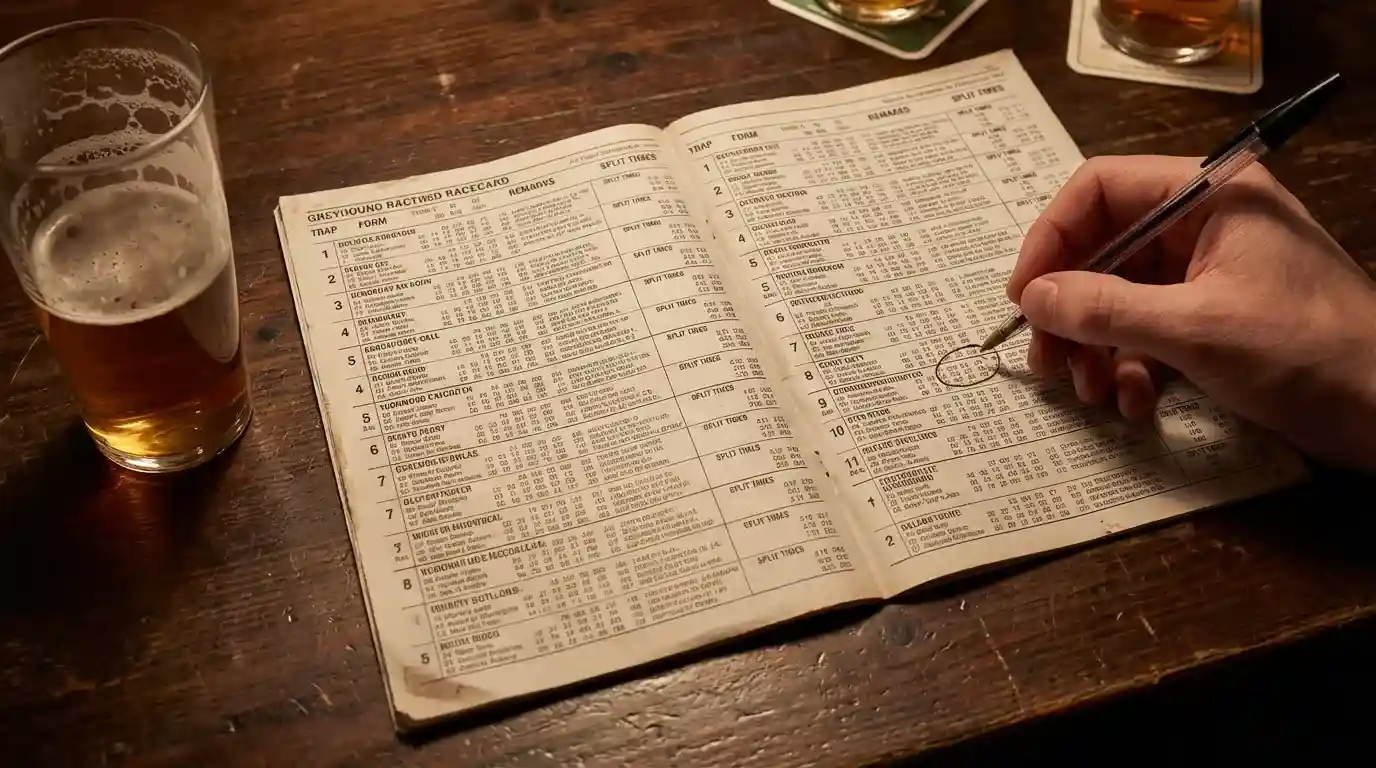
Form figures are the sequence of numbers (and occasionally letters) that represent each dog's finishing position in its most recent races. A form line of 1-3-2-4-1-2 tells you the dog won its most recent race, finished second before that, fourth before that, and so on back through six runs. The numbers run from 1 (first) to 6 (last). Letters flag special circumstances: F means fell, R means the dog was retired mid-race, and a dash or T indicates a trial run with no competitive placing.
Beyond the raw finishing position, each previous run carries a set of details that reveal far more than where the dog ended up. The date and venue tell you how recent the form is and whether the dog has run at this particular track before — an important consideration, since performance varies significantly between venues. The distance column confirms whether the dog was racing over a comparable trip, because a sprint specialist's form over 480 metres has limited relevance to a 660-metre staying race.
The trap number for each previous run shows which box the dog started from. This matters because some dogs perform measurably better from specific traps. A railer — a dog that prefers running close to the inside rail — will typically have stronger form figures from traps 1 and 2 than from trap 5 or 6. If the dog is drawn in trap 1 tonight and its best runs all came from that same position, the form is more reliable than the raw numbers suggest.
In-running remarks are the shorthand commentary that describe how a race unfolded for each dog. These abbreviations are critical. EPace means the dog showed early pace. SAw means slow away from the traps. Crd indicates the dog was crowded — squeezed for room — during the race. Bdblk means badly baulked, which is a more severe interference. VW stands for very wide, meaning the dog lost ground by running wider than ideal around the bends. A dog that finished fourth but was crowded at the second bend and baulked at the third is not the same proposition as a dog that finished fourth in a clear run. The remarks separate genuine ability from circumstantial bad luck.
None of this data exists in isolation. The form figures tell you what happened; the remarks tell you why; the trap draw and distance tell you whether the context was favourable. Reading a racecard is about synthesising all of these elements — along with the dog's weight and trainer record — into a single assessment of each runner's realistic chance.
Split Times & Calculated Times
Raw winning time means nothing without the going correction. Two dogs can clock identical times on different nights and be separated by lengths in actual ability, because the track surface changes every session depending on weather, watering and how many races have already been run.
The split time — sometimes called the sectional time — records how quickly a dog reaches the winning line for the first time, which on most UK tracks corresponds to completing the run from the traps to the first bend and then down the back straight. This number is your best indicator of early speed. A dog that consistently posts fast splits is likely to lead the field into the first bend, and the first-bend leader has a statistical advantage that far exceeds any other single variable. We will return to this point later, because it underpins the most effective selection strategy available.
Calculated time, abbreviated CalcTm on most racecards, adjusts the actual winning time by the going allowance for that particular session. The going — expressed as a positive or negative number in hundredths of a second — represents how fast or slow the track surface was running relative to the normal standard (indicated by N). If the going is +10, the track was running slow, and ten hundredths of a second are added to the raw time to produce the calculated time. If the going is -5, the surface was fast, and five hundredths are subtracted. The result is a time that can be compared fairly across different racing nights and different conditions.
An asterisk next to a calculated time on the racecard denotes the dog's best recent time over the distance at that track. This is your benchmark figure. When comparing two dogs that have raced at the same venue over the same distance, the asterisked CalcTm gives you the most reliable speed comparison available — far more trustworthy than looking at unadjusted winning times.
Form and times tell you what each dog can do individually — but the trap draw determines whether it will get the chance to do it.
Form tells you what happened — the trap draw tells you what will happen next.
Trap Draw & Running Styles
Before you look at form, look at the box. The trap draw is the single most underappreciated factor in greyhound racing, and ignoring it is the quickest way to turn a solid form analysis into a losing bet. In a six-runner race on a tight oval track, where the dogs hit the first bend within three to four seconds of leaving the traps, starting position dictates traffic. And traffic dictates results.
Every greyhound has a preferred running line. Some hug the inside rail — these are the railers. Others prefer the middle of the track, and are tagged as middle runners. A third group runs widest, designated as wide runners. In graded racing, the Racing Manager at each track allocates dogs to traps based on their running style under Rule 76 of the GBGB regulations. Railers are drawn inside, typically trap 1 or 2. Middle runners go into traps 3 or 4. Wide runners get traps 5 or 6. The logic is safety: dogs running their preferred line from the correct starting position are less likely to cause or suffer interference.
Open races are drawn differently. Under Rule 80, the draw is randomised within each seeding category, meaning a railer can end up in trap 5 or a wide runner in trap 2. The resulting cross-traffic at the first bend can be severe, making open race trap draws far more important to analyse than graded cards.
Inside rail. Favours railers with fast early speed. Best position on tight tracks where the first bend comes quickly.
Trap 2 — Blue
Second from rail. Suits dogs looking to tuck in behind or in front of the trap 1 runner. Often the first to get crowded if two railers are drawn 1 and 2.
Trap 3 — White
Inside-middle. A neutral position. Suits adaptable dogs that can rail or run a middle line depending on early traffic.
Trap 4 — Black
Outside-middle. Offers a clear initial run on wider tracks. Can be disadvantageous on tight courses where the dog has ground to make up.
Trap 5 — Orange
Wide berth. Benefits dogs with strong early pace that can lead into the bend from a wider angle. Often favoured on galloping tracks.
Trap 6 — Black & White Stripes
Widest draw. Adds extra ground to cover on the first bend. Strong trap at sweeping courses like Towcester, weak trap at tighter venues like Romford.
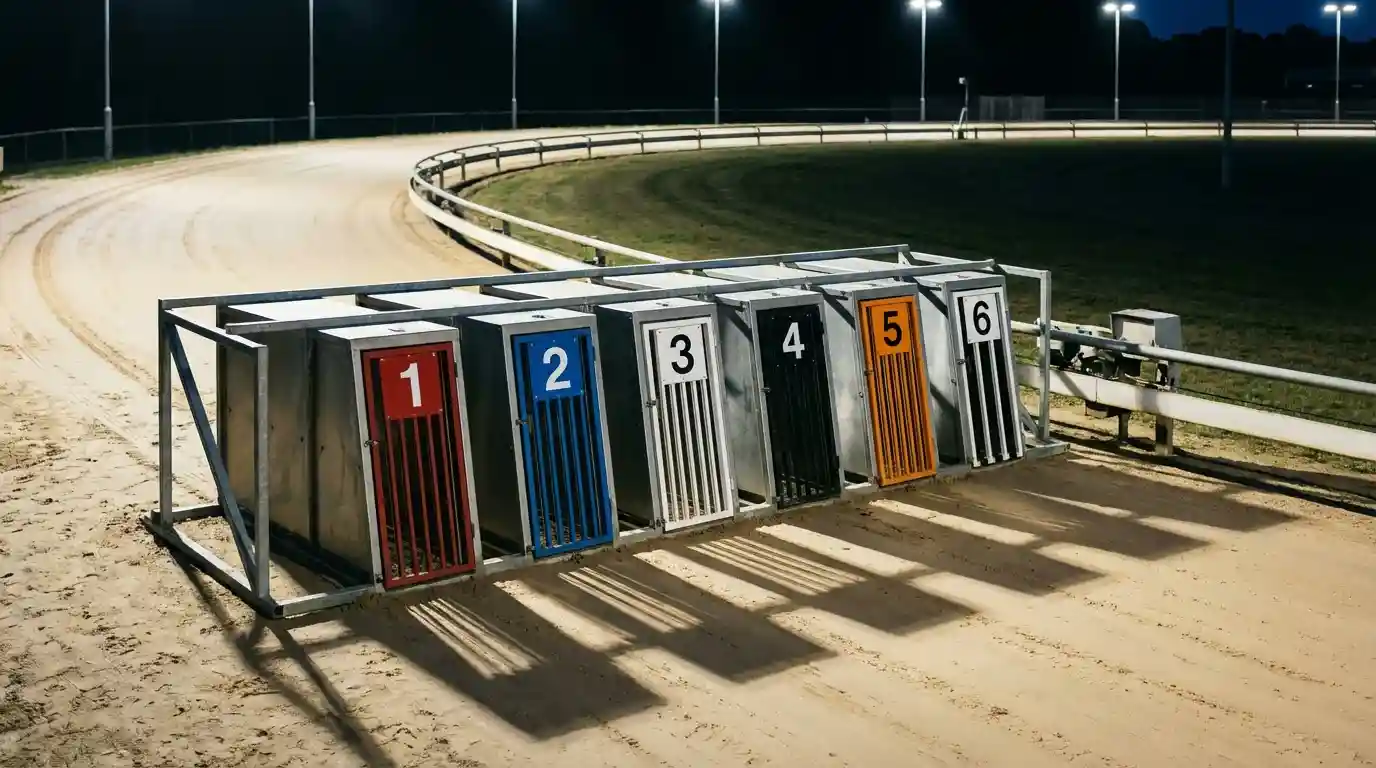
Trap bias — the tendency of certain trap numbers to produce more winners at a given track — is real and measurable. At some venues, trap 1 winners significantly outperform the other five positions over a full year of results. At others, the outside traps dominate. The bias is a product of track geometry: bend radius, distance from traps to the first turn, and the camber of the surface all influence which dogs get a clean run and which get squeezed.
The practical implication is straightforward. A dog with strong form from its preferred trap at a track where that trap number historically performs well is a far stronger proposition than the same dog drawn out of position at a venue with the opposite bias. Always check the draw before you check the form.
Greyhound Bet Types: From Singles to Tricasts
You don't need exotic bets to make money at the dogs — but you do need to know they exist. The relatively small field size in greyhound racing makes certain bet types considerably more realistic than their horse racing equivalents. A tricast in a 20-runner handicap hurdle is a needle-in-a-haystack exercise. A tricast in a six-dog race with two clear class standouts is a genuine strategic play. Understanding the full range of bet types allows you to match your level of conviction to the right wager.
The win bet is the foundation. You pick a dog to finish first. You can take a price — locking in the current odds offered by the bookmaker — or bet at starting price (SP), meaning your payout is determined by the odds at the moment the traps open. Taking a price is almost always preferable if you believe you have spotted value early, because starting prices can shorten significantly if money comes for the same dog.
A place bet requires your dog to finish first or second. In six-runner races, only two places are paid at a quarter of the win price. You need your selection to be at least 4/1 to get your money back on a place-only bet. At shorter prices, place betting on greyhounds is rarely worthwhile.
The each way bet combines a win bet and a place bet into a single wager — but it costs double your unit stake. A £10 each way bet costs £20 total: £10 on the dog to win, £10 on the dog to place. If the dog wins, both halves pay out. If it finishes second, only the place part returns. Each way becomes attractive at prices of 4/1 and above, particularly for dogs with strong form but questionable finishing consistency. Below 4/1, the place return is too small to justify the doubled outlay.
Example: £10 each way at 5/1
Total stake: £20 (£10 win + £10 place)
Dog wins: Win return = £60 (£50 profit + £10 stake). Place return = £22.50 (5/4 = £12.50 profit + £10 stake). Total return: £82.50. Profit: £62.50.
Dog finishes second: Win part loses (−£10). Place return = £22.50. Net profit: £2.50.
Dog finishes third or worse: Both parts lose. Loss: −£20.
A forecast bet requires you to name the first two finishers. In a straight forecast, the order must be exact — your first pick finishes first, your second pick finishes second. A reverse forecast covers both possible orders but costs twice as much. The payout is calculated by a computer formula (the Computer Straight Forecast, or CSF) based on the starting prices of the two dogs. Forecast bets can generate returns that dwarf singles markets, particularly in competitive races where the first two home are not the obvious favourites.
A tricast bet extends the principle to three finishers. Straight tricasts require exact order across first, second and third. Combination tricasts cover all possible orders among your selected dogs, but the cost escalates quickly: three dogs in a combination tricast means six bets, four dogs means 24 bets.
Multiples — doubles, trebles and accumulators — link selections from different races, and all legs must win for the bet to pay. The returns compound, but so does the risk. Forecast doubles and trebles are also available, combining forecast selections across multiple races. A trap challenge, offered by some bookmakers, lets you bet on which trap number will produce the most winners across an entire meeting — a novelty market with limited analytical edge.
Forecasts & Tricasts in Practice
A three-dog combination tricast on a £5 unit costs £30 — six bets covering every permutation of first, second and third among your three selections. That is a significant outlay for a single race, and it only makes sense when the race profile is right: a clear top three separated from the rest of the field by visible class or speed.
The straight forecast is the sharper tool. If your analysis gives you high confidence in both the winner and the runner-up — say, a fast railer in trap 1 who should lead throughout, and a strong finisher in trap 4 who consistently runs into second — a straight forecast at a fraction of the combination cost delivers better value per pound staked.
Straight forecast vs combination tricast — cost comparison
Straight forecast (2 dogs, exact order): 1 bet. £5 stake = £5 total.
Reverse forecast (2 dogs, any order): 2 bets. £5 stake = £10 total.
Combination tricast (3 dogs, any order): 6 bets. £5 stake = £30 total.
Combination tricast (4 dogs, any order): 24 bets. £5 stake = £120 total.
The tricast dividend is notoriously volatile. Because payouts are calculated from a formula based on starting prices rather than fixed odds, two races with similar-looking results can produce wildly different returns. A tricast landing at three short-priced dogs might return £15 for a £1 stake. The same tricast with one outsider finishing third could return £150. This unpredictability makes tricasts exciting but dangerous as a primary strategy. They work best as occasional plays in races where you have a strong read on the likely front three, rather than as a systematic approach.
Forecast doubles and trebles compound the difficulty further: you are combining forecast selections across multiple races, and every additional race multiplies the ways your bet can fail. The returns are enormous when they land. They just don't land very often.
Core Betting Strategies for the Dogs
Every profitable greyhound punter I know starts with the same question: who leads at the first bend? That question sits at the centre of the most effective selection method in dog racing, and the rest of this section builds outward from it. But the first-bend leader method is not the only viable approach. Below, we break down the four-pillar framework that underpins most serious greyhound betting, and contrast it with the increasingly popular lay strategy.
The four pillars are class, current form, early speed and trap draw. None works in isolation. A dog with brilliant early speed drawn in the wrong trap is neutralised. A class act returning from injury with two poor runs is a risk, not a certainty. The skill lies in weighing all four factors against each other and deciding which one dominates in any given race.
Class is the grade at which a dog is currently racing — A1 (highest) down to A11 in graded racing, with separate criteria for open competitions. A dog dropping from A3 to A5 may be declining, or it may have been unlucky and now meets weaker opposition. Context matters: look at the reasons for the grade change, not just the direction.
Current form is the last three to four runs, not the last six. Older form fades in relevance quickly. Look for consistency — repeated placings in the first three — and factor in the remarks. A dog that finished third after being crowded at the second bend has better underlying form than one that finished third in a clear run.
Early speed is the engine of the four-pillar model. The greyhound that leads the field around the first bend wins more often than any other variable predicts. Statistically, across all UK graded racing, first-bend leaders convert at close to 50% — a figure that dwarfs the average win rate of the pre-race favourite. To identify the likely leader, compare split times from recent runs at the same venue and distance. The dog with the fastest average split, drawn in a trap that gives it a clear run to the bend, is your projected leader.
Trap draw determines whether a dog's speed and running style can be expressed cleanly. A fast railer in trap 1 at a tight track is the ideal scenario. The same dog in trap 5 may struggle to cross the field before the bend, causing interference that disrupts the entire race.
First-Bend Leader Method
Focus: identify the dog most likely to lead at the first bend using split times and trap draw.
Strengths: statistically the highest-converting single factor in greyhound racing. Works best in graded races where seeding is correct.
Weakness: underperforms in open races with random draws. Vulnerable when two fast dogs are drawn adjacent.
Best for: win and forecast bets on graded cards.
Lay Betting Strategy
Focus: identify dogs likely to lose. Lay short-priced favourites on Betfair or Betdaq when the form does not support the price.
Strengths: consistent small returns. Favourites lose roughly 64% of graded races. You only need them to lose.
Weakness: liability risk if a short-priced favourite wins. Requires disciplined bank management.
Best for: exchange users who prefer steady accumulation over big individual wins.

Lay betting inverts the traditional approach. Instead of finding winners, you look for losers — specifically, short-priced favourites whose price does not reflect their actual chance. With favourites in graded racing winning approximately 35.7% of the time across the 2024 season, nearly two-thirds of all graded races see the favourite beaten. The lay bettor exploits this by opposing dogs with identifiable weaknesses: poor trap draw, declining form, or a running style that conflicts with adjacent runners.
Neither method is superior in absolute terms. The first-bend leader approach demands race-by-race analysis and works best with singles and forecasts. Lay betting suits punters who want a more systematic, portfolio-style approach with lower variance. Some bettors use both — backing their selections in favourable races and laying vulnerable favourites in others.
Spotting Value in Greyhound Markets
A 2/1 shot that should be 6/4 is not value — it's charity for the bookmaker. Value exists when the odds offered are higher than the dog's actual probability of winning, as estimated by your own analysis. This is not guesswork. It is a repeatable assessment process that starts with pricing the race yourself before you look at the market.
Begin by assigning a rough percentage chance to each of the six runners. Consider the four pillars — class, form, speed, draw — and distribute 100% across the field. If your analysis gives Dog A a 30% chance of winning, the fair odds are approximately 10/3 (or 4.33 in decimal). If the bookmaker is offering 4/1 (5.00), that dog is overpriced relative to your assessment, and the bet has positive expected value. If the bookmaker offers 2/1 (3.00), the price implies a 33% chance — higher than your 30% estimate — and the bet is value-negative.
Interactive Tool
Fair Odds Checker, and Derby Heat Races Calculator
Verify the guide's own fair-odds example against the correct maths, and calculate how many heat races 180 Derby entries actually implies.
Correct Fair Odds
-
-
Your Probability
-
Guide's Claim
-
Claim's Real Implied %
-
What this guide states as a worked example: "If your analysis gives Dog A a 30% chance of winning, the fair odds are approximately 10/3 (or 4.33 in decimal)." Checking the maths: 10/3 fractional actually implies a 23.1% chance, not 30%. The correct fair odds for a 30% chance are roughly 7/3 (decimal 3.33).
Implied Heat Races
-
-
Total Entries
-
Dogs Per Race
-
Exact Division
-
What this guide states without the follow-through: "The 2026 Derby heats are expected to draw around 180 entries" — but with six dogs per race (the standard field size stated throughout the guide), the number of heat races is never calculated. It works out to exactly 30 heats.
The reason this works better in greyhound racing than in most other sports is market inefficiency. Greyhound markets receive far less analytical attention than football or horse racing. There are no syndicate operations crunching greyhound data on the scale that exists in thoroughbred racing. The result is that bookmaker prices, particularly for BAGS meetings at lower-profile tracks, are often set by algorithm with limited manual oversight. Errors in pricing happen regularly.
Best Odds Guaranteed promotions amplify your edge further. Several UK bookmakers offer BOG on selected greyhound races, meaning if you take an early price and the SP drifts higher, you are paid at the better number. Over hundreds of bets, the cumulative impact on your level stakes profit is substantial. Betfair and Betdaq offer a complementary angle: exchange odds strip out the bookmaker's margin, though liquidity in greyhound markets is thinner than in horse racing, particularly on morning and afternoon cards.
UK Greyhound Tracks: What You Need to Know
Not every track races the same, and the dog that dominates Romford can struggle at Towcester. The UK's 18 GBGB-registered stadiums vary in circuit size, bend radius, standard distances, surface quality and local quirks that affect race outcomes in ways the racecard alone cannot capture. Knowing the characteristics of the tracks you bet on is a legitimate competitive advantage — and one that most casual punters ignore entirely.
Towcester is the showpiece venue, purpose-built for modern greyhound racing and home to the English Greyhound Derby since 2021. The track is wide and galloping, with sweeping bends that reward stamina and running style over raw early pace. The standard trip is 500 metres, and the first bend comes later than at most UK tracks, which means early speed matters slightly less and sustained pace matters more. Wide runners tend to fare better here than at tighter venues, and the trap 6 win rate is historically stronger than the national average. The 2026 Derby heats are expected to draw around 180 entries from the country's leading kennels, making it the defining event on the calendar.
Romford, in east London, is the opposite. The circuit is tight, the bends are sharp, and the first turn comes up fast. Early speed from inside traps is heavily rewarded, and railers with quick break times dominate the results. Friday nights at Romford are an institution in London greyhound racing, with strong open-race cards that attract quality fields. The standard distances are 400 and 575 metres.
Hove, on the south coast near Brighton, is widely regarded as one of the best all-round tracks in the country. Evening cards are strong, and the track's layout is fair to most running styles. It hosts several Category One and Category Two events through the year, and trainers based in the south of England tend to target Hove for their better dogs. The surface is well-maintained and the going is generally consistent, which makes form figures from Hove more reliable than some other venues.
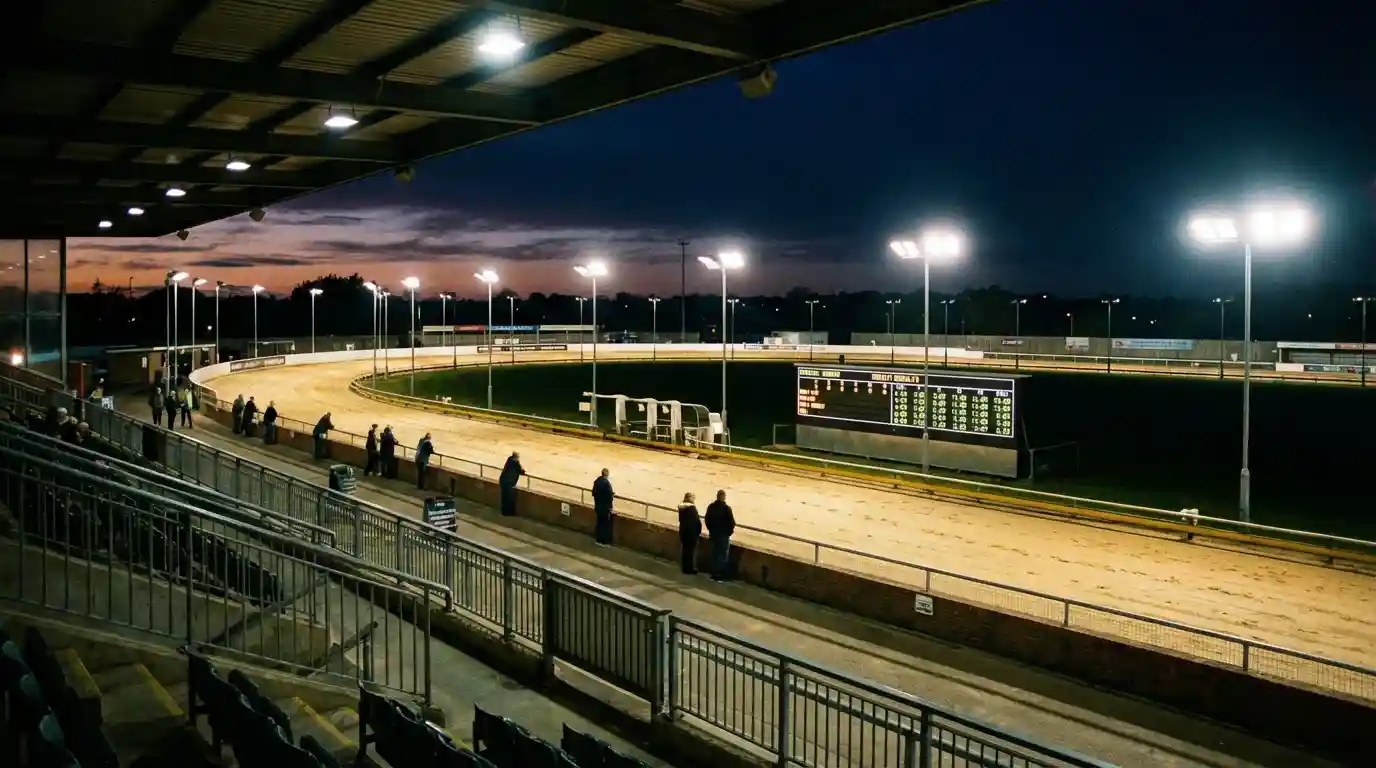
Monmore Green in Wolverhampton offers a high competitive standard in graded racing, with a good mix of sprint and staying events. It features regularly on RPGTV schedules and provides consistent midweek evening cards.
Nottingham is a demanding track where dogs need to sustain their pace through four bends. The Arena Racing Company uses it for marquee competitions including puppy classics, and it has hosted both the English Greyhound Derby and the St Leger in previous years.
Sheffield similarly favours strong-running types. Front-runners that fade in the closing stages are a regular sight, and results here can mislead if extrapolated to smaller, faster circuits.
Beyond these flagship venues, tracks like Crayford, Sunderland, Newcastle, Doncaster, Swindon and Perry Barr each have their own character. Crayford's fair layout suits consistent dogs, Sunderland runs fast and tight, and Perry Barr's longer distance makes it a natural home for staying races. With the last independent track closing in March 2025, every sanctioned race in Britain now falls under the GBGB umbrella — consolidating the sport under a single regulatory standard for the 2025-26 season and beyond.
The practical lesson is specialisation. Trying to follow every race at every track is a recipe for superficial analysis. Most successful greyhound bettors focus on two to four venues, study them in depth — results, trap bias, going patterns, trainer form — and develop a level of knowledge that algorithms and casual punters cannot match.
Track-Specific Trap Bias
Trap bias isn't a conspiracy — it's geometry. The angle and distance from traps to the first bend, combined with the bend radius itself, mechanically favour certain starting positions at each venue. On a tight left-hand circuit like Romford, trap 1 has the shortest distance to cover into the first turn, and a fast dog starting there will reach the rail position without needing to cross the path of other runners. On a sweeping course like Towcester, the wider traps suffer less disadvantage because there is more room and more time before the bend arrives.
Over a full year of results, the trap bias at a given track becomes statistically visible. Some venues show trap 1 winning at rates significantly above the expected 16.7% baseline, while others — particularly larger, galloping tracks — show a more even distribution or even a bias toward higher-numbered traps. The annual statistics published by the GBGB and compiled by services like OLBG give you a baseline, but the most useful bias data comes from your own records over a concentrated period at tracks you follow regularly.
Important: Trap bias is not static. It can shift season to season as track surfaces are resurfaced, as watering schedules change, and as the going varies with weather patterns. A trap 1 bias that held through a dry summer may weaken during a wet winter when the rail becomes less forgiving. Review your bias data every eight to twelve weeks.
The most dangerous trap bias error is applying national averages to individual tracks. The fact that trap 1 wins more often overall across all UK tracks does not mean trap 1 is the best draw at Sheffield or Newcastle. Each track must be assessed independently, and the bias must be verified against recent results — not historical averages from five years ago.
How Greyhound Odds Work
In a six-runner race, the margin for error in pricing is razor-thin — and that's where your edge lives. Greyhound odds represent the bookmaker's assessment of each dog's chance of winning, expressed as a price. Understanding how those prices are set, how they move, and where the built-in profit margin sits is essential for any bettor who wants to operate above the level of random selection.
UK greyhound racing traditionally uses fractional odds. A dog priced at 3/1 returns £3 profit for every £1 staked, plus the stake back. The implied probability is calculated by dividing the denominator by the sum of numerator and denominator: 1 / (3+1) = 25%. Decimal odds — standard on exchanges and increasingly common on bookmaker sites — express the same information as total return per £1 staked: 3/1 becomes 4.00 in decimal (£3 profit + £1 stake). For computational purposes, decimals are simpler. For traditional punters at the track, fractional remains the default.
The bookmaker builds a profit margin — called the overround — by ensuring the combined implied probabilities of all six runners exceed 100%. In greyhound racing, overrounds typically range from 115% to 130%, significantly higher than the 5-10% margins on Premier League football. This is precisely why greyhound markets offer scope for value betting: the margins are fat enough that informed bettors can find dogs priced above their true probability.
The starting price is the industry-standard price at the moment the traps open. If you bet at SP, you accept whatever price is returned. If you take a price earlier, you lock in that number regardless of subsequent market movement. Taking an early price is advantageous when you identify value before the market corrects — and this is where Best Odds Guaranteed changes the equation.
Market movement in greyhound racing is driven by a mix of factors: money from betting shop punters, online activity, kennel confidence (trainer-connected money), and algorithmic adjustments by bookmaker trading teams. A dog that shortens sharply — known as a steamer — may be backed on information: a trainer's confidence, a good trial, a weight improvement. A dog that drifts — lengthens in price — may be expected to face trouble in running, or may simply not be attracting support. Neither signal is infallible, but consistent steamers are worth noting as a data point alongside your form analysis.
Best Odds Guaranteed & Its Real Impact
BOG is free money — the only question is which bookmakers actually offer it on the dogs. Best Odds Guaranteed means that if you take an early price on a greyhound and the starting price turns out to be higher, the bookmaker pays you at the better number. You keep the upside of SP drift without the downside of missing an early value price that subsequently shortens. It is one of the few promotions in betting that has zero drawback for the punter.
Not every bookmaker extends BOG to greyhound racing. Several of the major UK firms — Coral, bet365, William Hill, Betfred — offer it on selected meetings, but the eligible races vary. Evening open-race cards are more commonly covered than morning BAGS meetings. Always check before placing the bet, because the difference over a full year of betting is material. A punter placing 500 bets annually who gains even a 0.3-point average improvement per bet from BOG is looking at 150 points of additional profit at level stakes.
Before you place your bet — checklist
- Confirm the race is eligible for BOG with your bookmaker.
- Compare the current price with your own tissue assessment. Is this value?
- Check for non-runners or reserve replacements that may have changed the race dynamic.
- Verify the dog's weight is within the 1kg tolerance from its last run.
- Review the going report for the current session — has the surface changed since the earlier races?
Managing Your Greyhound Betting Bank
The fastest way to go broke betting on greyhounds is to chase losses — the second fastest is to have no staking plan at all. Bankroll management is the unsexy foundation that everything else rests on. Your selection skills are irrelevant if your staking approach allows two bad nights to wipe out a month of profits.
Flat staking is the simplest and most widely recommended approach. You bet the same amount — your unit stake — on every selection, regardless of confidence level or odds. A common guideline is to set your unit at 1-2% of your total betting bank. If your bank is £500, your unit stake is £5 to £10. This approach absorbs losing runs without catastrophic damage, and it makes profit-and-loss tracking straightforward: your level stakes profit (LSP) after a set number of bets tells you exactly how your selections are performing.

Percentage staking adjusts the stake based on the current bank balance. If your bank grows, your stake increases proportionally; if it shrinks, so does the stake. This method protects against depletion more aggressively than flat staking, because the stake falls as the bank decreases. The downside is complexity and the temptation to override the system when you feel strongly about a selection.
What does not work — ever — is the martingale approach: doubling the stake after every loss on the assumption that the next win will recover everything. In greyhound racing, where six runners mean even the best selections lose more often than they win, a losing streak of five or six races is common. Doubling up from a £10 base reaches £320 by the sixth consecutive loss. The mathematics of martingale are brutal and unavoidable.
Do
- Set a fixed unit stake before each week or month of betting.
- Record every bet: date, race, selection, odds, stake, result, running P&L.
- Review your results over a minimum of 50 bets before changing strategy.
- Set a stop-loss for each session — a maximum number of units you are prepared to lose in one evening.
Don't
- Increase stakes to recover losses from earlier races.
- Bet on the last race of the night just to "get something back."
- Use money you cannot afford to lose as your betting bank.
- Abandon your staking plan because one selection "can't lose."
The betting record is non-negotiable. Without a log, you have no idea whether your approach is profitable, breakeven or slowly bleeding. Record the selection, the odds taken, the result, the in-running remarks (to revisit later), and the running profit or loss after each bet. A spreadsheet is sufficient. The discipline of entering every result — including the losses — forces accountability that gut feeling alone cannot provide.
Common Questions About Greyhound Betting
Three questions every newcomer asks — and the honest answers might surprise you.
How often does the favourite win in greyhound racing?
In graded racing across UK tracks, the market favourite wins roughly one race in three — GBGB data consistently returns a strike rate in the 35-36% range. That means the shortest-priced dog loses nearly two-thirds of the time.
The percentage varies by track and race type. Kinsley has historically returned lower favourite strike rates around 31-32%, while venues like The Valley have pushed above 40%. Open races tend to see slightly higher favourite conversion because short-priced contenders in opens are usually there on genuine class.
The practical takeaway: assess whether the price reflects the dog's actual chance. A 6/4 favourite that your analysis gives a 40% win probability is fair. The same dog at even money is poor value.
What is the best trap number in greyhound racing?
There is no universally "best" trap number. Trap bias is entirely track-specific and changes depending on the venue's geometry, surface and conditions. At tight tracks with sharp bends — Romford being the classic example — trap 1 tends to produce a higher-than-expected proportion of winners because the inside runner has the shortest route to the first turn. At wider, galloping tracks like Towcester, the advantage shifts outward and traps 5 and 6 hold their own or even outperform.
National aggregate data can be misleading. If you average trap 1 performance across all UK tracks, it appears to have a slight overall edge — but that average is dragged up by a handful of tight-track venues. At tracks with wide, sweeping bends, the inside trap advantage evaporates. The only reliable way to assess trap bias is to study results at the specific track you are betting on, over a recent and representative sample of races.
How do you read greyhound form numbers?
Greyhound form is displayed as a string of numbers representing the dog's finishing position in its most recent races, read from right (oldest) to left (most recent). A form line of 2-1-3-4-1-5 means the dog's last race was a second-place finish, the one before that a win, then third, fourth, first and fifth going back six runs.
Numbers range from 1 (first) to 6 (sixth/last). Letters indicate non-standard outcomes: F means the dog fell during the race, and R means it was retired — pulled up or otherwise unable to complete. A T denotes a trial run, which is non-competitive and does not carry betting implications. Dashes or blank entries mean no run was recorded for that slot.
The form numbers alone are only a starting point. To get the full picture, you need the in-running remarks alongside each result, the trap drawn, the venue, the grade and the calculated time. A sequence of 4-4-4-4 from a dog that was crowded or baulked in every race is not the same as 4-4-4-4 from clear runs.
The Final Bend: Why the Dogs Reward Patience Over Instinct
The dogs don't care about your staking plan — but your bank balance does. Greyhound betting is not a game of intuition, lucky trap numbers or backing the dog with the best name. It is a process of information gathering, systematic evaluation and disciplined execution, repeated hundreds of times over. And it rewards that process more honestly than almost any other betting market available.
The reason is structural. Greyhound racing operates below the radar. There are no television pundits dissecting every race, no social media tipster armies driving prices down on obvious selections, no sophisticated syndicates vacuuming up value before the casual punter gets a look in. The greyhound market is thin, under-analysed and inefficiently priced. For the bettor willing to do the work, this is a gift.
But the absence of noise does not mean the absence of difficulty. Your biggest opponent in greyhound betting is yourself. The temptation to chase losses, to abandon a staking plan after a bad run, to overbet on a "certainty" or to skip the form analysis because you fancy a quick punt on the last race — those impulses destroy more greyhound betting banks than any streak of unlucky results ever could.
The process outlined in this guide — reading form, understanding the trap draw, choosing the right bet type, pricing the race yourself, managing your bank — is not complicated. None of it requires specialised software or insider connections. It requires consistency. It requires the willingness to record every bet, review every month, and accept that even a profitable strategy will lose more individual races than it wins. A 30% strike rate at average odds of 3/1 is profitable. It also means losing seven out of every ten bets. If you can stomach that ratio and stick to the plan, greyhound racing will pay you back.
Thirty seconds per race, 365 days a year, 18 tracks — the opportunities never stop arriving. The question is whether your preparation keeps up.
