
Greyhound Racing for Beginners & First Night Betting
Best Greyhound Betting Sites – Bet on Greyhounds in 2026
 Available in US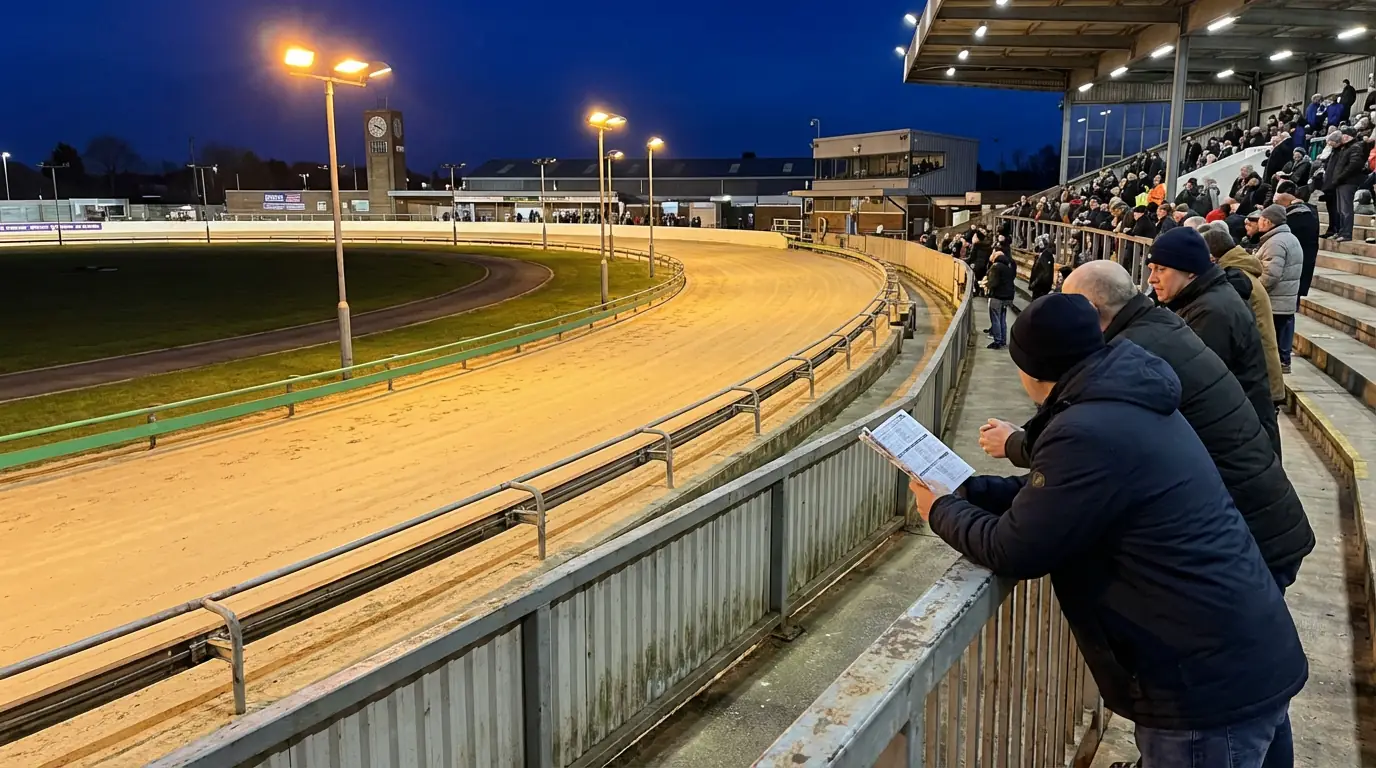
Beginner Essentials: Core Concepts for Your First Bets
Your first night at the greyhound track is a sensory experience that no amount of reading can fully prepare you for. The mechanical hare whipping around the rail, six dogs exploding from the traps in a blur of coloured jackets, thirty seconds of noise and speed, and then it is over. Another race in ten minutes. That rhythm — fast, repetitive, relentless — is what makes greyhound racing unlike any other sport to bet on.
The good news for beginners is that greyhound racing is genuinely one of the most accessible forms of betting. The fields are small — six dogs per race. The races are short — typically under 30 seconds. The racecard information is standardised and, once you know what you are looking at, remarkably informative. You do not need years of experience or specialist knowledge to start. You need a basic understanding of how races work, how to read the form, and how to place a bet without overspending.
This guide is the starter kit. It covers the essentials: race mechanics, placing your first bet, understanding the odds, and a simple approach to picking your early selections. Save the advanced strategy for later — tonight is about getting comfortable with the sport.
As a newcomer, you might want to start with safer options like greyhound each way betting to minimize your risks.
How Greyhound Races Work
A standard greyhound race in the UK features six dogs chasing a mechanical hare around an oval sand track. The dogs start from numbered starting boxes — called traps — numbered 1 through 6, with trap 1 on the inside and trap 6 on the outside. Each dog wears a coloured jacket matching its trap number: red for trap 1, blue for 2, white for 3, black for 4, orange for 5, and black-and-white stripes for 6.
The hare runs on a rail around the inside or outside of the track, depending on the venue, and the traps open as it passes. The dogs sprint after the hare, usually reaching top speed within the first few strides. Most races are over standard distances of 400 to 500 metres, though sprint races as short as 240 metres and staying races above 600 metres also feature on some cards.
A typical meeting at a UK greyhound stadium runs between 10 and 14 races across an evening session, with races going off roughly every 12 to 15 minutes. Daytime BAGS meetings — races staged primarily for the off-course betting market — follow a similar structure but with shorter gaps between races. On any given day, there might be four or five different meetings running simultaneously at venues across the country.
Before each race, the dogs are paraded in front of the stands so spectators can see their physical condition. The parade is a tradition at evening meetings and a genuine source of information for experienced punters. A dog that looks relaxed and moves freely is generally in better shape than one that appears agitated or stiff. After the parade, the dogs are loaded into the traps, the hare is set running, and the race begins.
Results are determined by photo finish if the margin between dogs is too close to judge with the naked eye. The official result, along with finishing distances and the winning time, is displayed on the venue’s screen and published online within minutes. Each dog’s performance — finishing position, in-running remarks, split time, and overall time — becomes part of its form record for future races.
Placing Your First Bet
If you are at the track, you can place a bet at the tote window or with an on-course bookmaker. The tote is a pool-betting system: all stakes go into a pool and the payout is divided among the winners. The on-course bookmaker offers fixed odds, meaning the price you see on the board is the price you get if you bet at that moment. For a first-timer, the tote is simpler — you just name the dog or trap number, the amount, and the bet type.
If you are betting online, the process is straightforward. Log in to your bookmaker account, navigate to the greyhound racing section, find the meeting and race you want to bet on, and click on the odds next to your selected dog. The selection is added to your bet slip, where you enter your stake and confirm. The whole process takes about 30 seconds.
For your first few bets, keep it simple. A win bet — backing one dog to finish first — is the most basic wager and the easiest to understand. You pick a dog, you choose a stake, and if the dog wins, you are paid at the advertised odds. If it loses, you lose your stake. Nothing more complicated than that.
Stake sizing matters from the very beginning. Set a budget for the evening before you place a single bet and divide it across the number of races you plan to bet on. If your budget is 30 pounds and you want to bet on six races, your stake per race is five pounds. This prevents the most common beginner mistake: betting too much too early and having nothing left for the last few races on the card. It also prevents the second most common mistake: chasing losses by increasing stakes after a losing bet.
You do not need to bet on every race. In fact, you probably should not. Watch a few races first. Get a feel for how the dogs run, how the traps influence the early pace, and how the results compare to the form. The races will still be there when you are ready.
Understanding the Odds
Greyhound odds in the UK are traditionally displayed in fractional format: 3/1, 5/2, 7/4, and so on. The first number tells you the profit, and the second tells you the stake required. At 3/1, you profit three pounds for every one pound you stake. At 5/2, you profit five pounds for every two pounds staked. Your original stake is always returned on top of the profit if the bet wins.
If fractional odds feel confusing at first, you can switch most online betting platforms to decimal format. Decimal odds show the total return per pound staked, including your stake. So 3/1 becomes 4.0 (three pounds profit plus one pound stake), and 5/2 becomes 3.5. Many beginners find decimal odds more intuitive because the number directly represents what comes back to you.
The favourite in a greyhound race is the dog with the shortest odds — the one the bookmaker considers most likely to win. In a six-runner race, the favourite wins around 35 to 36 per cent of the time across all graded races. That means roughly two out of every three races are won by a dog other than the favourite. This is worth remembering because it sets expectations: even if you always back the favourite, you will lose more often than you win. The question is whether the odds compensate for the losing frequency, and that is where the real analysis begins.
Starting Price, abbreviated to SP, is the price at which the market settles when the race begins. If you do not take a fixed price before the off, your bet will be settled at SP. Early prices are available on most races from the morning onwards, and these can be higher or lower than the eventual SP depending on how the market moves. For beginners, accepting SP is perfectly reasonable until you develop the confidence to assess whether an early price represents good value.
One concept worth understanding early: short odds do not mean a certainty. A dog at 4/6 is not guaranteed to win. It means the bookmaker thinks it has roughly a 60 per cent chance, which also means a 40 per cent chance of losing. Greyhound racing is fast, chaotic, and six dogs in close proximity create interference that can derail any form analysis. Respect the odds, but never treat them as facts.
A Simple Strategy for Your First Few Meetings
Forget systems, tipsters, and complicated form analysis for now. For your first few meetings, use a stripped-back approach that teaches you how to read a racecard while keeping your stakes sensible and your expectations realistic.
Start by looking at the racecard for each race and identifying the dog with the lowest trap number that has the most recent wins. Trap 1 or trap 2, with a win in its last two or three runs, is a simple starting filter. Inside trap runners with recent winning form have two things going for them: they are drawn on the favourable side of the track at most venues, and their confidence from winning recently is reflected in their running. This is not a sophisticated method, but it forces you to look at the racecard, check the form figures, and make a decision based on data rather than gut feeling.
As you get more comfortable, add one layer: check the split time. If the dog you have identified also has the fastest or second-fastest split time among the six runners, your confidence in the selection increases. Early speed from an inside trap is a powerful combination at any level of greyhound racing, and learning to spot it early in your betting career builds a habit that will serve you for years.
Keep your bets to win singles only. No each way, no forecasts, no accumulators — not yet. Win bets are the simplest to track, the easiest to assess, and the most instructive for learning. After each meeting, review your selections: which won, which lost, and why. Did the winner lead at the first bend? Did your selection get into trouble? Did you miss something on the racecard that would have changed your decision? That post-meeting review is worth more than any tip you could buy.
Set a budget for each meeting and stick to it without exception. A reasonable starting bank for an evening of greyhound racing might be 20 to 40 pounds, divided into level stakes across the races you choose to bet on. If you lose the budget, stop. If you finish ahead, stop. The discipline of walking away — whether winning or losing — is the single most important habit a beginner can develop, and it is easier to build from the start than to learn after a costly evening.
The Learning Curve Is the Fun Part
Greyhound racing has a gentler learning curve than almost any other betting sport. The fields are small, the races are frequent, and the feedback loop is fast — you find out whether your selection was right within 30 seconds. That speed of feedback accelerates learning in a way that horse racing or football betting cannot match.
Your first few meetings will be full of mistakes, and that is entirely fine. You will back a dog that gets crowded at the first bend. You will miss a form figure that pointed clearly to the winner. You will bet on a race you should have sat out. Each of these mistakes teaches you something specific, and the cumulative effect of those lessons is what turns a beginner into a competent greyhound punter.
Do not rush the process. The dogs race every day, every evening, all year round. There is no window closing, no season ending, no urgency. Take your time, keep your stakes small, and treat the first month as tuition rather than an investment. The returns will come later — once you have paid the entrance fee that every punter pays in the form of early losses and hard-earned experience.
Start your betting journey on the right foot with our comprehensive UK greyhound betting guide.
