
Greyhound Ante Post Betting & Early Markets
Best Greyhound Betting Sites – Bet on Greyhounds in 2026
 Available in US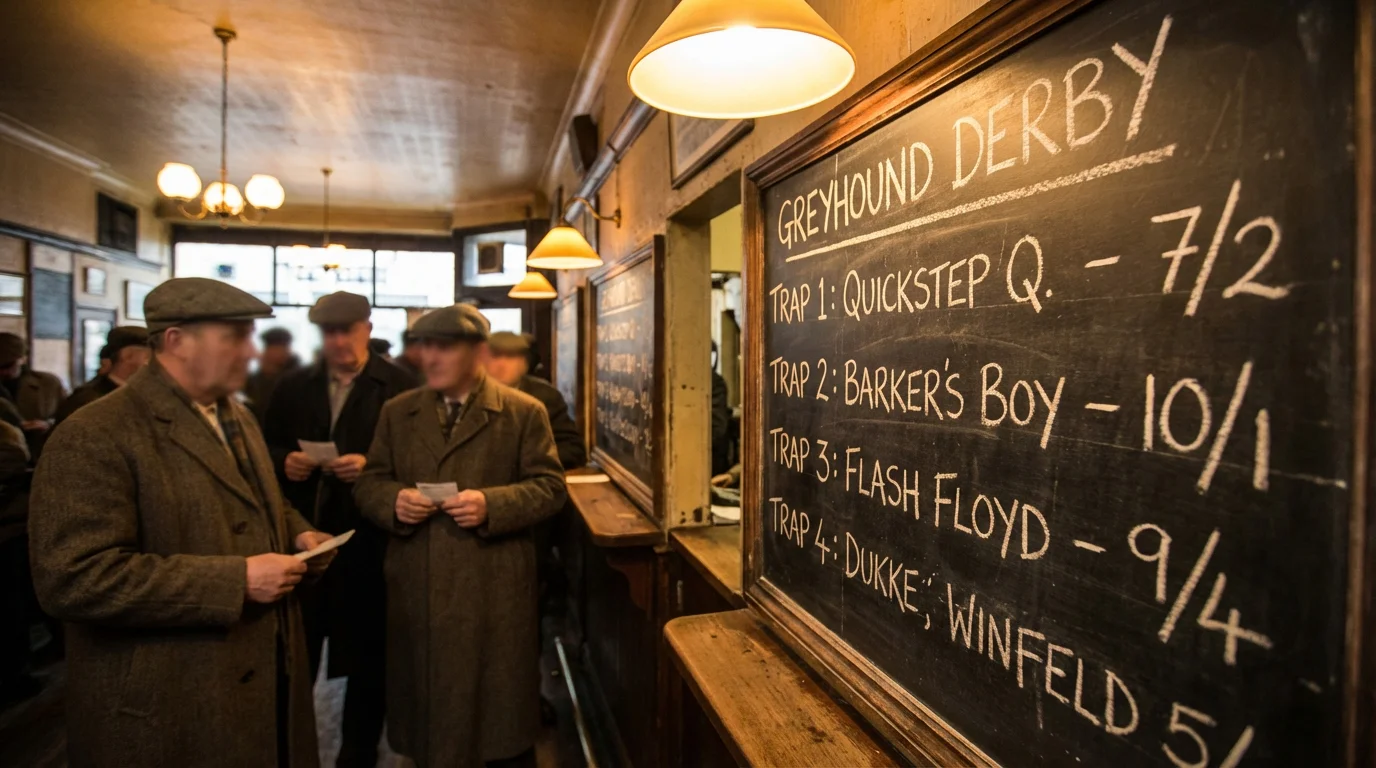
Ante Post Markets: Early Pricing in Greyhound Racing
Ante post betting is placing a wager on an event that has not yet started — and in some cases, on a dog that has not yet qualified. The market opens weeks or even months before the competition takes place, and the prices on offer reflect both the probability of a dog winning and the additional risk that it might never reach the race at all.
In greyhound racing, ante post betting centres almost exclusively on the major events: the English Greyhound Derby, the St Leger, the Oaks, and a handful of other prestigious competitions that follow a multi-round qualification format. These are the occasions when bookmakers build dedicated markets with prices on dozens of potential runners, and where the early prices can be dramatically more generous than anything available once the competition is underway.
The catch is simple: if your dog does not make it to the final, your stake is gone. No refund, no second chance. That risk is the defining feature of ante post betting, and understanding how to manage it is the difference between using ante post markets as a strategic tool and treating them as a lottery.
How Ante Post Betting Works in Greyhound Racing
Ante post markets on greyhound racing open when a bookmaker decides the event is significant enough to price. For the Derby, this might happen weeks before the first qualifying heat. For smaller cup competitions, the ante post window may only open a few days before the event begins. The timing varies by bookmaker and by event, but the principle is the same: you are betting at odds that will almost certainly change — often substantially — between now and the race.
When you place an ante post bet, the price is fixed at the moment of placement. If you back a dog at 25/1 three weeks before the Derby final and it progresses through the heats to become the 5/2 favourite, you still hold your bet at 25/1. That price compression is the core appeal of ante post betting. Your early judgment, if correct, is rewarded with odds that later punters cannot access.
The market adjusts as the competition unfolds. After each round of heats, dogs that impress will shorten in the ante post market while those that disappoint or are eliminated will drift or be removed entirely. If your selected dog is eliminated, your bet is lost regardless of the reason — injury, poor performance, failure to qualify, or withdrawal by the trainer. There is no refund mechanism in standard ante post betting.
Some bookmakers offer non-runner no bet terms on selected events, which refund your stake if the dog does not participate. These terms come at the cost of shorter prices, and the full mechanics are covered below in the non-runner rules section.
Ante post bets are typically settled on the outright winner of the competition. Some markets also offer place terms — betting on a dog to reach the final, for example, or to finish in the first three — though these are less common in greyhound racing than in horse racing. Where available, ante post place betting can be a useful way to profit from a dog’s progress through the competition without needing it to win outright.
Risk and Reward: Why Early Prices Are Bigger
Ante post prices are longer than race-day prices for a reason that has nothing to do with generosity. The bookmaker is pricing in the risk that the dog does not run. If a dog has a 20 per cent chance of winning the final but only a 60 per cent chance of reaching the final, the combined probability is 12 per cent. The ante post price reflects that combined figure, not the 20 per cent win probability alone.
This is the mathematical trade-off at the heart of every ante post bet. You are paid extra for absorbing the risk of non-participation. If you are confident that a dog will both reach the final and compete strongly when it gets there, the ante post price offers a premium over the eventual race-day price that compensates you for a risk you consider unlikely to materialise. If the dog is fragile, inconsistent, or facing a tough qualification route, the extra price may not adequately cover the danger.
The reward profile is asymmetric in a useful way. A successful ante post bet on a Derby winner at 20/1, placed weeks before the final, produces a return that is impossible to replicate through standard race-day betting. The same dog might start the final at 3/1 or 4/1 after winning its heats and semi-final impressively. The price contraction between the ante post bet and the starting price represents pure profit that was created by timing, not by any additional risk taken on race day.
The risk profile is also asymmetric, but in the opposite direction. A losing ante post bet on a dog that is eliminated in the second round of heats is a total loss. There is no near-miss, no consolation payout, no partial recovery. The stake is gone the moment the dog fails to progress, regardless of how well it ran. Managing this all-or-nothing dynamic requires strict discipline with stake sizing, which is why ante post betting should always be treated as a small, speculative portion of your overall betting activity.
Non-Runner Rules and What Happens to Your Stake
The standard rule in ante post betting is unforgiving: if your selection does not run, you lose. This applies whether the dog is injured the day before the final, withdrawn by the trainer, or eliminated in a qualifying round. The bet was placed on the dog to win the event, and if it does not win the event — for any reason, including never reaching the event — the bet is settled as a loser.
This rule exists because the price you received accounted for the possibility of non-participation. The bookmaker did not offer 20/1 because it thought the dog had a 5 per cent chance of winning the final. It offered 20/1 because it assessed a combined probability that included the chance of the dog never getting there. Refunding non-runners would require shorter ante post prices across the board, which would eliminate the very value that makes ante post betting attractive.
Some bookmakers offer non-runner no bet terms on specific events, typically the biggest competitions like the Derby. Under NRNB, your stake is refunded if the dog does not participate in the nominated race — usually the final. The prices under NRNB terms are shorter than standard ante post prices, reflecting the reduced risk, but they offer a safety net that many punters find worthwhile. If NRNB is available and the price difference is modest, it is generally the smarter choice unless you have strong reason to believe the dog will definitely reach the final.
A tactical consideration: the definition of “non-runner” under NRNB terms varies by bookmaker. Some define it as the dog not participating in the final. Others may define it as the dog not being in the competition at all. The distinction matters. A dog that enters the competition but is eliminated in the semi-finals may not qualify as a non-runner under some NRNB terms, meaning your stake is still lost. Always read the specific terms for each bookmaker’s NRNB policy before placing an ante post bet under those conditions.
For standard ante post bets without NRNB, the only protection is stake sizing. Keep individual ante post stakes small enough that losing them entirely does not affect your overall betting bank in any meaningful way. A reasonable guideline is to limit total ante post exposure on any single event to no more than two to three per cent of your bank, spread across one or two selections.
Which Greyhound Races Offer the Best Ante Post Value
The English Greyhound Derby is the headline ante post event and the one that generates the deepest and most liquid market. The extended qualification format — heats, quarter-finals, semi-finals, and a final — means the ante post market is open for weeks, with prices adjusting after each round. This creates multiple opportunities to bet: before the heats start, after the first round narrows the field, and again after the semi-finals when the six finalists are known.
The St Leger and the Oaks also generate ante post interest, though the markets are thinner and the prices less competitive. Staying events tend to be harder to assess from a form perspective because the stayers’ division is smaller and the form lines are less well established. This can work in the ante post punter’s favour, because the uncertainty means the prices are wider and the market is more likely to misprice a dog with genuine credentials.
Track-specific cup competitions occasionally attract ante post markets, though these are usually offered closer to the event and with fewer selections priced. The Romford Puppy Cup, the Hove Sussex Cup, and similar venue-level competitions may have ante post markets available through selected bookmakers, particularly those with a strong greyhound racing presence. The value in these smaller markets can be significant because they attract less attention from professional punters and the prices are set with less sophisticated modelling.
Puppy competitions in the spring and early summer are an underrated ante post opportunity. Young dogs develop rapidly, and a puppy showing promising form in March might be a serious contender by June but still priced generously in the ante post market because it lacks the established reputation of an older, more proven dog. Following puppy form closely during the early months of the year and identifying improvers before the market catches up is one of the most reliable ante post angles in the sport.
The worst ante post bets are on events where you have no informational advantage. Betting blind on the Derby favourite at 5/1 ante post when you have not studied the qualification route, the likely heat draws, or the dog’s track record at Towcester is not ante post betting — it is speculating. The value in ante post markets comes from knowing something the market has not yet priced, and that requires homework that goes beyond the headline name.
The Long View: Patience as a Betting Currency
Ante post betting rewards a different temperament from everyday race-by-race wagering. You place a bet and then wait — days, weeks, sometimes months — while the competition unfolds and your selection’s fate is determined by events beyond your control. There is no instant gratification, no 30-second resolution. The bet sits in your portfolio, its value fluctuating silently as the market adjusts around it.
That patience is the price of the premium. Ante post prices are longer because most punters cannot tolerate the wait, the uncertainty, and the possibility of losing a stake to a non-runner weeks after placing the bet. If you can tolerate those things — and if your analysis is sound — the ante post market offers returns that the standard race-day market simply cannot match.
Use it sparingly, stake it sensibly, and treat every ante post bet as a position you are prepared to lose entirely. The winners, when they arrive, will justify the patience. And if a particular competition does not present a clear opportunity, the discipline of doing nothing is worth more than the thrill of having a bet on every event.
