
BAGS Racing Guide & Bookmaker Service
Best Greyhound Betting Sites – Bet on Greyhounds in 2026
 Available in US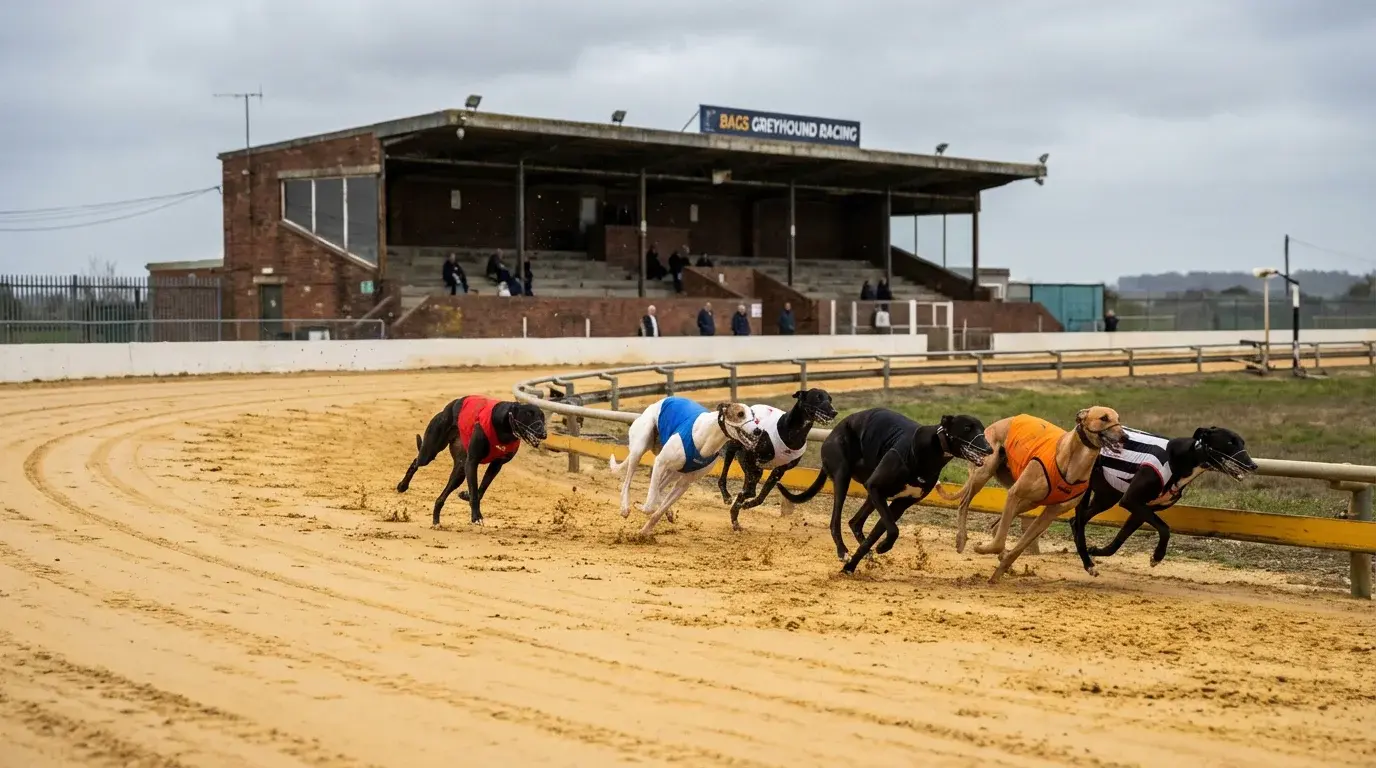
UK Greyhound Betting: BAGS Racing Service Infrastructure
If evening meetings are the shopfront of greyhound racing, BAGS is the engine room. The Bookmakers’ Afternoon Greyhound Service provides the daytime racing that fills the betting shops and powers the online markets from late morning through to early evening, every day of the week. It is unglamorous, relentless, and completely central to the economics of both the sport and the betting industry.
Most casual observers of greyhound racing have never heard of BAGS. Most regular punters bet on it daily without giving the acronym a second thought. Understanding how BAGS works, what distinguishes its racing from the evening cards, and how to approach betting on these meetings is essential knowledge for anyone who bets on UK greyhound racing with any regularity.
This guide explains the structure, the viewing options, the betting strategy, and the grading context that defines BAGS racing as a product distinct from, yet deeply connected to, the wider greyhound racing programme.
What Is BAGS Racing and How Does It Work?
BAGS stands for Bookmakers’ Afternoon Greyhound Service. It is the commercial arrangement between the greyhound racing industry and the off-course bookmaking sector that provides a supply of live greyhound racing during the daytime hours when there is no evening or weekend racing to service the betting market.
The system works through a scheduling agreement: selected GBGB tracks host daytime meetings specifically for BAGS. These meetings are staged not primarily for on-track attendance — the crowds at BAGS meetings are minimal — but for the off-course betting market. The races are filmed, streamed, and made available to bookmakers who use them to populate their greyhound markets throughout the day.
BAGS meetings typically begin around 10am or 11am and run through to approximately 5pm, with races every 15 minutes. Multiple tracks race simultaneously, so at any given point during the afternoon there might be three, four, or five BAGS meetings running in parallel. This steady supply of races means there is almost always a greyhound market open somewhere in the UK during daytime hours, providing the bookmakers with continuous product and the punters with continuous betting opportunities.
The financial model behind BAGS is straightforward. Bookmakers pay a media rights fee to show the races and use them as a betting product. The tracks receive this fee as a revenue stream that supplements their income from evening meetings and on-course attendance. For many smaller tracks, the BAGS revenue is a significant proportion of their total income and, in some cases, the primary financial justification for their continued operation.
The tracks that host BAGS meetings rotate according to the schedule published by the governing body. Some tracks are BAGS fixtures almost every day; others appear less frequently. The schedule is published in advance and available through the Racing Post, bookmaker racing cards, and online greyhound racing portals, making it straightforward to plan your betting around the available meetings.
The race interval at BAGS meetings — typically every 12 to 15 minutes — is designed to synchronise with the needs of the off-course betting market. Each race generates a new set of markets, a new set of prices, and a new settlement cycle. For the bookmaker, this regular cadence keeps the shop floor or the website active throughout the quieter daytime hours. For the punter, it provides a constant supply of opportunities but also a constant temptation to over-bet. The rhythm of BAGS racing is seductive: there is always another race in a few minutes, always another chance to recover a loss or extend a winning run. Managing that rhythm is part of the discipline challenge.
Where to Watch BAGS Meetings
BAGS meetings are available primarily through bookmaker live streams. The major UK bookmakers stream all BAGS meetings through their desktop and mobile platforms, typically requiring only a funded account or a small qualifying bet on the meeting. This makes the coverage effectively free for anyone who has an active bookmaker account.
RPGTV covers selected BAGS meetings but not all of them, with the dedicated channel focusing more on the higher-profile evening cards. Sky Sports Racing occasionally includes BAGS fixtures in its schedule but is not a reliable source for comprehensive daytime coverage. For complete access to every BAGS meeting, the bookmaker stream is the primary and most consistent option.
Betting shops remain a viewing option for BAGS racing. The in-shop screens display live coverage from BAGS meetings throughout the afternoon, and for punters who prefer the social environment of the shop, this is a straightforward way to watch and bet on the races. The in-shop experience provides the added benefit of seeing the market form in real time alongside other punters, though the analytical resources available are more limited than what can be accessed online.
Betting Strategy for BAGS Racing
BAGS racing has its own betting characteristics that differ from evening meetings, and the punter who adjusts their strategy accordingly will find more consistent returns from the daytime programme.
The first characteristic is the tighter grading. BAGS fields are typically graded more precisely than evening fields, meaning the dogs within each race are closer in ability. This makes form analysis both more important and more subtle: small differences in calculated time, trap draw advantage, or recent form trajectory can separate the contenders, and the market tends to reflect these tight margins with compressed odds ranges. Three or four dogs in a BAGS race might be priced between 2/1 and 4/1, with no clear standout.
The second characteristic is predictability. Because BAGS racing is graded rather than open, and because the dogs are running at their local track in familiar company, the results tend to be more formful than evening cards that include open races, inter-track events, or cup competitions. Favourites win at a slightly higher rate in BAGS racing than in evening racing, which is good news for punters who can identify genuine value favourites and bad news for those who back every market leader indiscriminately.
The third characteristic is volume. With races running every 15 minutes across multiple tracks, the temptation is to bet on every race. This is a trap. Selectivity is even more important in BAGS racing than in evening racing because the sheer number of available races can erode discipline. Set a quota for the day — three to five bets maximum — and choose only the races where your analysis gives the clearest edge. The rest are races to watch, not races to bet on.
Forecast betting is particularly well suited to BAGS racing. The tight grading and smaller ability gaps mean the first two home often come from a predictable shortlist, and the CSF returns on BAGS races are frequently generous because the starting prices are close together. A 2/1 and 3/1 combination in a BAGS forecast can return significantly more than the equivalent combination in a wider-priced evening race.
Graded Quality: What to Expect From BAGS Fields
The grading at BAGS meetings covers the full spectrum, from A1 down to A10 or A11 depending on the track. The overall quality of the fields is honest but typically below the standard of the evening cards at the same venue, because trainers tend to reserve their best dogs for the higher-profile evening meetings where the prize money is better and the competition is stiffer.
This does not mean BAGS racing is inferior from a betting perspective — it means it is different. The dogs running at a BAGS meeting are competing within their grade, and the form is just as readable as at any evening meeting. What changes is the absolute speed of the dogs and the margin for error in the grading. A dog that is slightly better than its grade will win more frequently in the tightly graded BAGS environment than it would stepping up to contest a stronger evening race.
The lower grades at BAGS meetings — A7, A8, A9 — can be particularly profitable for form students. These grades attract less market attention, meaning the prices are set with less precision and the opportunities for value are more frequent. The dogs at these levels are less consistent, which means the form is more volatile, but a punter who has been following a specific dog’s recent progression can identify runners on the upgrade before the market adjusts.
One practical consideration: BAGS meetings use the same tracks and the same trap draw biases as the evening meetings. The rail bias that favours trap 1 at a tight track is just as relevant at a Tuesday afternoon BAGS card as it is at the Saturday evening flagship meeting. Do not treat BAGS form in isolation from the track data you use for evening racing — the venue characteristics are identical regardless of the time of day.
Another consideration is the crossover between BAGS form and evening form. Dogs that run well in BAGS races during the week are sometimes entered in evening races at the weekend, and vice versa. Recognising a dog that impressed at a BAGS meeting three days ago and is now running in stronger evening company — or conversely, an evening performer dropping to BAGS level — is a practical form-reading skill. The BAGS and evening programmes at the same track are not separate ecosystems but interconnected parts of the same racing operation, and the punter who reads across both programmes has a more complete picture than the one who treats them as independent.
The Quiet Card That Pays the Bills
BAGS racing will never generate headlines. It does not produce the drama of the Derby or the atmosphere of a packed Saturday evening at a major track. It is methodical, repetitive, and entirely unglamorous — which is exactly why many profitable greyhound punters focus their attention on it.
The tighter grading creates more predictable outcomes. The higher frequency creates more opportunities. The lower market attention creates more mispriced runners. For the disciplined, selective punter who treats BAGS racing as a data exercise rather than an entertainment product, the daytime programme is a consistent and largely untapped source of betting value.
It is the quiet card that pays the bills. Respect it, study it, and let the evening cards provide the entertainment.
