
History of UK Greyhound Racing & Evolution
Best Greyhound Betting Sites – Bet on Greyhounds in 2026
 Available in US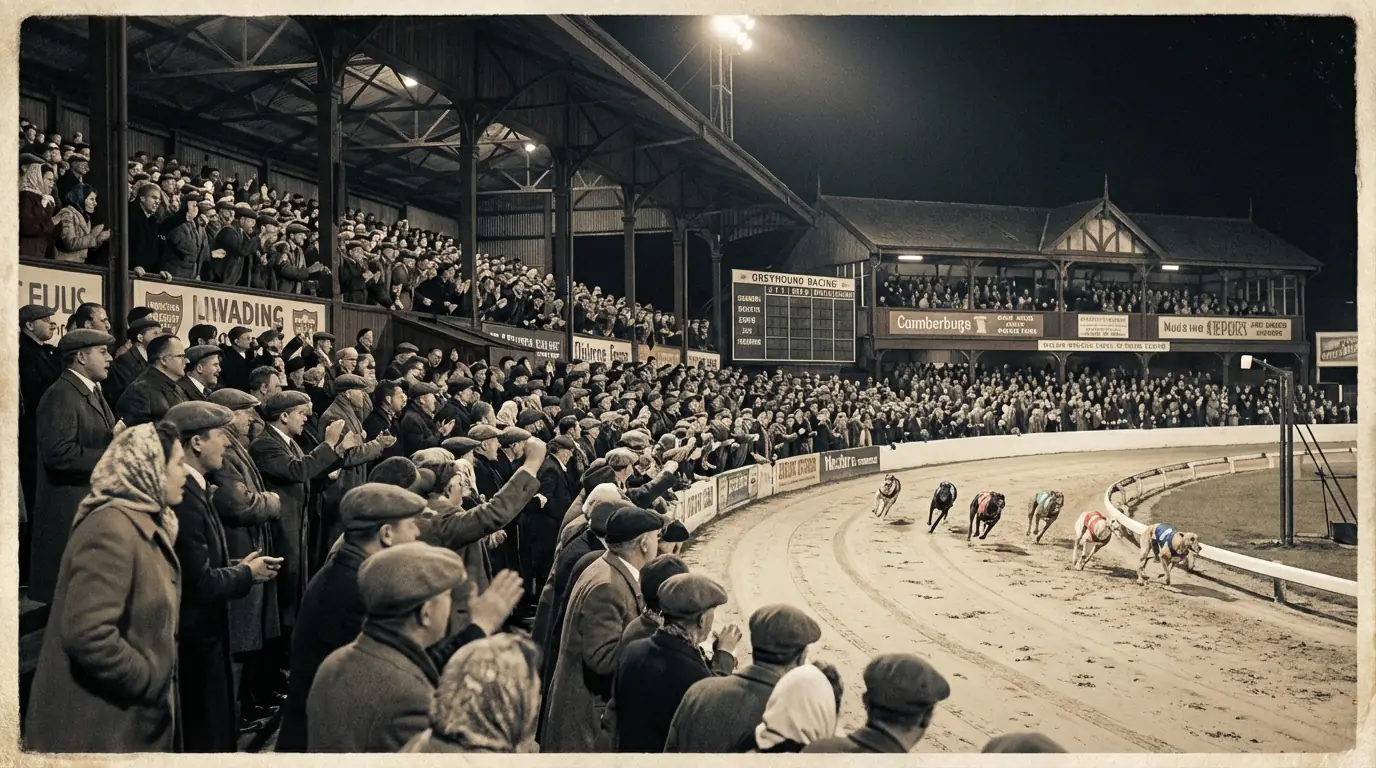
Sport Evolution: Historical Development of Dog Racing
Greyhound racing in Britain is approaching its centenary, and the story of those hundred years is one of extraordinary popularity, cultural significance, gradual decline, and determined survival. It is a story worth knowing, not because history makes you a better bettor — it does not, directly — but because understanding where the sport came from explains why it looks the way it does today: the track layouts, the grading system, the relationship with the betting industry, and the resilience that keeps the sport running when every decade seems to bring predictions of its demise.
From the first organised race at Belle Vue in 1926 to the modern GBGB-regulated sport of 2026, greyhound racing has been shaped by social change, commercial pressure, and the enduring appeal of watching fast dogs chase a mechanical hare. This is that story, told in the broad strokes that matter.
Belle Vue, 1926: Where It All Started
The first official greyhound racing meeting in Britain took place at Belle Vue Stadium in Manchester on 24 July 1926. The event was modelled on the American version of the sport, which had been using a mechanical lure — an artificial hare running on an electrified rail — since the early 1920s. The mechanical lure was the innovation that made organised greyhound racing possible: it replaced the live hare coursing that had been practiced for centuries and created a format that could be staged reliably in a stadium setting with paying spectators.
The Belle Vue meeting was an immediate commercial success. The sport arrived at a moment when Britain’s industrial working class was hungry for accessible, affordable entertainment, and greyhound racing delivered precisely that. Meetings were held in the evening, after the working day, and admission was cheap. The tracks were built in or near urban centres, making them walkable for the communities they served. Within months of the Belle Vue opening, promoters across the country were racing to build new stadiums.
By the end of 1927, there were more than 40 licensed greyhound tracks operating in England, Scotland, and Wales. The expansion was driven by a combination of genuine public enthusiasm and speculative investment — some tracks were well-run commercial operations, others were hastily assembled ventures that collapsed within a year. But the overall trajectory was clear: greyhound racing had found its audience, and that audience was growing rapidly.
The Greyhound Racing Association, formed in 1926, established the regulatory framework that would govern the sport through its formative decades. The National Greyhound Racing Club, the precursor to today’s GBGB, was established in 1928 to oversee rules, licensing, and integrity. These governing structures gave the sport a legitimacy that helped it weather the inevitable scrutiny that came with its association with betting — an association that was, from the very beginning, central to the sport’s commercial model.
The Golden Era: 1930s to 1960s
The interwar period and the decades following the Second World War represent the golden era of British greyhound racing. Attendance figures that seem almost unbelievable today were routine: in 1946, an estimated 75 million admissions were recorded across British greyhound tracks. The sport was the second most-attended spectator activity in the country, behind only football.
The appeal was multifaceted. Greyhound racing was accessible — located in every major city and most large towns, with meetings held multiple evenings per week. It was social — the stadiums included restaurants, bars, and entertainment facilities that made a night at the dogs an event rather than just a sporting fixture. And it was affordable — admission and betting were within reach of working-class budgets in a way that horse racing, with its more rural locations and higher costs, often was not.
The tracks themselves became landmarks. White City in London, which opened in 1927, hosted the English Greyhound Derby and became synonymous with the sport at its most prestigious. Wimbledon, Wembley, Catford, Hall Green, Harringay — these were venues with their own character, their own traditions, and their own fiercely loyal followings. The stadium was not just a racing venue; it was a community hub that occupied a central place in the social life of its neighbourhood.
The sport produced genuine stars. Mick the Miller, a brindle dog from Ireland, became the first greyhound to capture the public imagination when he won the Derby in 1929 and 1930. His fame extended beyond the sport: he appeared in a feature film, was a household name across Britain, and remains the most famous greyhound in British racing history. Later dogs — Ballyregan Bob, Scurlogue Champ, Westmead Hawk — became legends within the sport, but Mick the Miller was the one who made greyhound racing a mainstream national pastime.
Track Closures and the Long Decline
The decline of greyhound racing began in the 1960s and accelerated through the following decades. The causes were multiple, interconnected, and largely beyond the sport’s control. Television kept people at home. Car ownership dispersed populations away from the urban centres where tracks were located. Alternative forms of entertainment — bingo, nightclubs, later the internet — competed for the same leisure spending. And the land on which the stadiums sat became increasingly valuable to property developers.
Track closures became the defining feature of the sport’s second half-century. White City closed in 1984, Wembley in 1998, Wimbledon in 2017. Each closure removed a piece of the sport’s heritage and reduced the total capacity for live greyhound racing. The closures were not limited to London: tracks in Birmingham, Bristol, Liverpool, Glasgow, and dozens of smaller towns shut their doors as the economics shifted against them. Land values in urban areas made selling to developers more profitable than continuing to operate as a racing venue.
The relationship between greyhound racing and the betting industry also shifted. The legalisation of off-course betting shops in 1961 initially benefited the sport by creating a new market for greyhound racing content — bookmakers needed races to fill their daily schedules, and greyhound meetings provided a steady supply. But the shops also reduced the incentive to attend in person: why go to the track when you could bet in the warm, dry comfort of a local shop? The BAGS system, which provided daytime racing specifically for the off-course market, became a vital revenue stream for tracks but also reinforced the trend away from on-course attendance.
The sport contracted but did not collapse. At each point where closure seemed imminent for the industry as a whole, the combination of betting revenue, committed ownership, and genuine public affection for the dogs kept enough tracks open to sustain a viable programme. The contraction was painful — every closed track represented lost jobs, lost tradition, and a reduced footprint for the sport — but the core of the industry adapted and survived.
The Modern Sport: 2020s and Beyond
UK greyhound racing in 2026 is a smaller, leaner sport than the one that packed stadiums in the 1950s. The number of active GBGB tracks has stabilised in the low twenties, down from a peak of several hundred. On-course attendance is a fraction of historical levels. The sport’s public profile is modest compared to football, horse racing, or even darts and snooker.
But the sport is far from dead. The betting market for greyhound racing remains substantial, driven by the daily BAGS programme, the evening meetings, and the accessibility of online betting and streaming. More greyhound races are watched in 2026 than at any point in history — not by stadium crowds, but by punters streaming races on their phones, tablets, and laptops through bookmaker platforms and RPGTV. The audience has shifted from physical to digital, and the commercial model has shifted with it.
Welfare reform has been a significant theme of the modern era. The GBGB’s regulatory framework now mandates comprehensive injury reporting, retirement tracking, and kennel inspection standards. Public scrutiny of greyhound welfare — driven by campaign groups, media investigations, and genuine concern from within the sport — has pushed the industry towards transparency and accountability in a way that would have been unrecognisable to the promoters of the 1930s. The sport’s long-term survival depends, in part, on demonstrating that the dogs are treated with care throughout and after their racing careers.
The major events — the English Greyhound Derby, the St Leger, the Oaks — retain their prestige and continue to generate genuine sporting excitement. The quality of the top greyhounds is exceptional, with modern training methods, nutrition, and veterinary care producing dogs that are faster, fitter, and more carefully managed than any previous generation. The sport at its highest level is thrilling to watch and analytically rewarding to bet on.
Knowing the Past, Betting the Present
The history of greyhound racing explains the shape of the sport you bet on today. The track layouts reflect decisions made in the 1920s and 1930s. The grading system evolved from decades of trial and error. The BAGS programme exists because of the commercial relationship between racing and betting that was established when the first off-course shops opened. And the vulnerability of the sport — the ever-present threat of further track closures — is a continuation of pressures that have been building for half a century.
None of this directly tells you which dog to back in the 7:30 at Romford. But it gives you context, and context sharpens judgment. The punter who understands the sport — not just the form, not just the odds, but the thing itself — is the punter who sees it most clearly. And clarity is the foundation of every good bet.
