
Greyhound Racecard Form Decoder & Live UK Track Stats
Best Greyhound Betting Sites – Bet on Greyhounds in 2026
 Available in US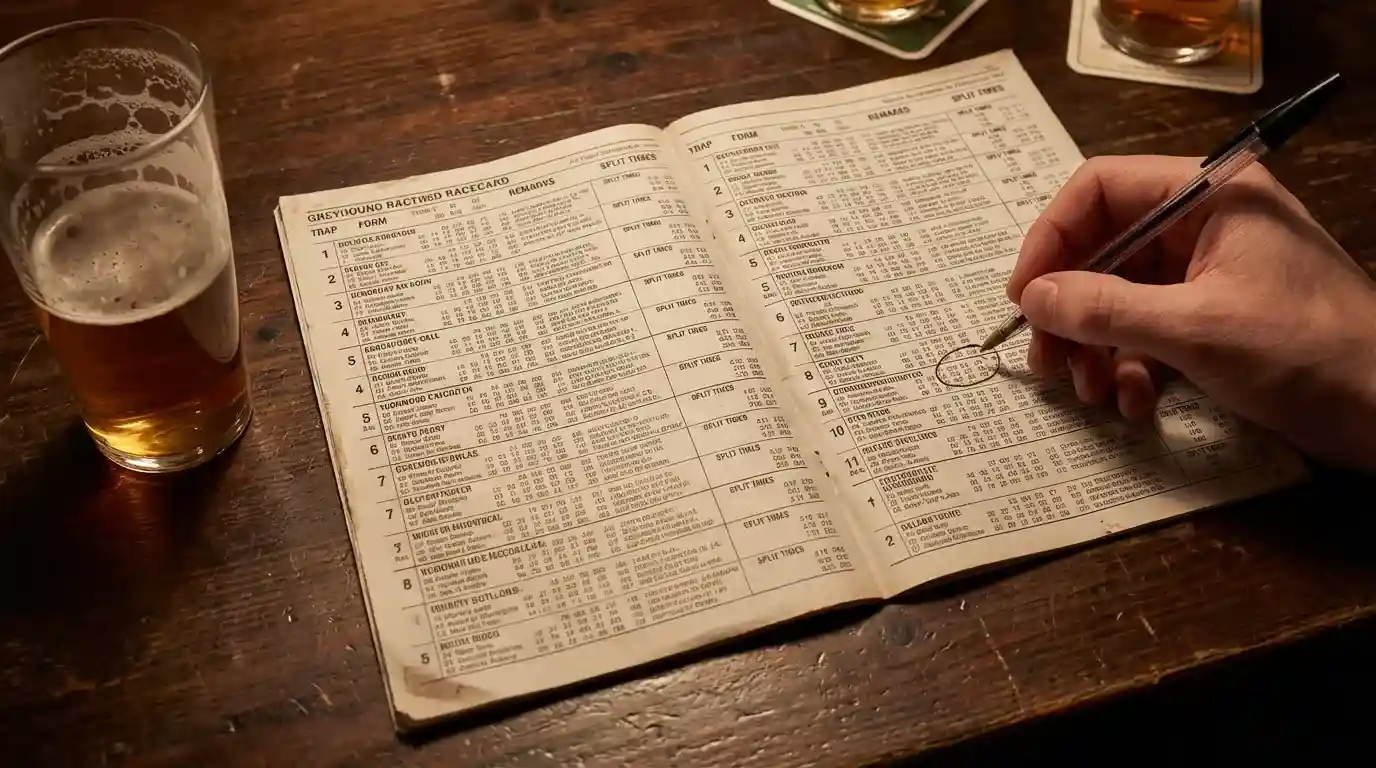
Form Decoding: Analyzing Racecard Lines and Figures
A greyhound racecard packs six races of history into a space smaller than a playing card. Open one for the first time and you’ll see a wall of abbreviations, numbers squeezed into narrow columns, and remarks that look like someone fell asleep on a keyboard. It’s enough to make a newcomer reach for the favourites page instead.
That’s a mistake. Every symbol on a racecard exists because it tells you something specific about a dog’s recent past — where it ran, how fast it got to the first bend, whether it was knocked sideways at the third, and how much the going affected its finishing time. Strip away the formatting and you have a miniature biography of each runner, written in a language that takes about twenty minutes to learn and a lifetime to master.
The racecard is divided into distinct layers. At the top sits the race header: time, distance, grade, prize money. Below that, each of the six runners gets a block containing its trap number, name, trainer, breeding, weight, and career record. Then comes the form line — the dense bit — where the last six runs are compressed into rows of data covering everything from sectional times to in-running comments. Finally, most cards include a calculated time and going adjustment, which allow you to compare dogs across different nights and different track conditions.
None of this is decorative. Once you can read each layer, the racecard stops being a puzzle and starts being a toolkit. The sections that follow break it down piece by piece, starting with the header and finishing with a full walkthrough of a sample card.
To fully understand a dog’s early pace, you must know how to analyze greyhound sectional times accurately.
The Race Header: Distance, Grade & Race Type
Before you look at a single dog, the header tells you what kind of race you’re dealing with. It sits at the top of each card and typically includes the off time, race number, distance in metres, grade designation, and prize money.
Distance is straightforward. UK greyhound racing uses metric measurements: sprints run over 240 to 285 metres, standard trips sit between 400 and 500 metres, and staying races stretch beyond 600 metres. The distance matters because dogs specialise. A rapid sprinter at Romford over 400 metres may have nothing to offer over the 480-metre trip at Towcester. Always check that a dog’s recent form is over a comparable distance to the race you’re assessing.
Grade is where things get more interesting. GBGB tracks use a grading system that ranges from A1 at the top down to A11 at some venues, slotting dogs into bands of similar ability. The grade reflects a dog’s current level as judged by the Racing Manager — win and you move up, trail in repeatedly and you drop. This creates a rolling handicap that keeps races competitive, but the real value for bettors lies in dogs moving between grades, which we’ll cover in detail later.
Beyond the standard A-grades, you’ll encounter abbreviations for different race types. OR means Open Race, where any dog can enter regardless of grade. S denotes a stakes race, ID an invitation event, and P or Puppy marks juvenile contests. There are also handicap races, where dogs start from staggered traps, though these are less common than in horse racing.
The header might look like background noise compared to the form data below it, but ignoring it is like reading a football match report without knowing which league the teams play in. Grade and distance frame everything that follows.
Individual Runner Information
Trap 3, white jacket — that’s all most casual punters notice, but there’s a wealth of data sitting right next to the name. Each runner’s block on the racecard is a compressed dossier, and learning to read it quickly separates the informed bettor from the pin-sticker.
The trap number and its corresponding jacket colour come first: 1 (red), 2 (blue), 3 (white), 4 (black), 5 (orange), 6 (black-and-white striped) (GBGB Rules — Rule 118). The dog’s name follows, along with the name of its owner and trainer. Knowing the trainer can matter more than you’d expect — certain kennels specialise in particular tracks, and a trainer with a strong record at a venue is always worth noting.
Next comes breeding: sire and dam. Greyhound pedigree influences running style more reliably than in many sports. Certain sire lines produce early-pace dogs that blaze to the front but fade late, while others throw stamina-laden stayers that grind through the field from the third bend onward. If you’re serious about reading racecards, building a mental library of sire characteristics pays dividends over time.
Age and sex are listed alongside. Most greyhound careers peak between two and four years old. Beyond four, physical decline is real but not universal — some dogs improve with experience, especially over longer trips. For bitches (female dogs), the card may note whether the animal is in season or has recently come back from a season break. This matters because a bitch returning from season can show dramatically improved or deteriorated form, and bookmakers don’t always adjust their prices accordingly.
The career record typically appears as a shorthand like 47 12-8-6, meaning 47 career starts, 12 wins, 8 seconds, and 6 thirds. A quick glance at the win-to-run ratio gives you an immediate sense of class. A dog with a 30% win rate in A2 is a different proposition from one managing 10% in A6. Weight in kilograms rounds out the runner block, and this small number carries more significance than its size suggests.
Weight, Age & Season Data
A kilogram shift in weight isn’t noise — it triggers an automatic withdrawal under GBGB’s Rule 52 if the dog is more than 1 kg above or below its last racing weight (GBGB Rules — Rule 52). So any weight listed on the card falls within a narrow band, but even small fluctuations within that band tell a story. A dog trending upward in weight might be building fitness after a break, or it might be carrying excess condition that blunts its early speed. A dog consistently at the lighter end of its range often signals peak fitness — lean, sharp, ready.
Age deserves more respect than most punters give it. Dogs under two years old are still learning the game. They may have raw talent but make positional errors: running too wide, flinching at the first bend, failing to chase the inside rail. By the time a dog reaches three, those rough edges are usually smoothed out. Once a dog passes its fourth birthday, physical decline becomes a factor — recovery from races slows, and the explosive early pace that defined its younger career may start to fade. That said, experienced stayers can defy the age curve because stamina is partly mental, partly mechanical.
Season data for bitches is one of the most underexploited edges on the racecard. When a bitch comes into season, she’s withdrawn from racing for a period, then returns with an unknown form profile. Some come back sharper, some duller, and the racecard gives you only the gap in dates to work from. If you see a break of several weeks between a bitch’s recent runs, check whether a season is the cause. The first two or three runs after a return are inherently volatile — and volatile form means the market is likely to get the price wrong.
Reading the Form Line
Six columns of data per race, six races per dog — and somewhere in those 36 cells is the answer. The form line is the densest part of the racecard and the one that rewards careful reading above all else. Each row represents a single previous run, with the most recent at the top. Read them from top to bottom and you get a chronological picture of what the dog has done lately — and, crucially, what it might do next.
A typical form line begins with the date of the run and the venue. This tells you how recent the information is and whether the dog has been racing at the same track it’s entered at today. A dog with five consecutive runs at the same venue has a known relationship with that track’s bends, distances, and surface. A dog shipping in from elsewhere brings uncertainty, which can cut both ways.
Next comes the trap number the dog ran from, followed by the split time — the time in seconds to reach the first bend. This is one of the most valuable numbers on the entire card, because it tells you whether the dog possesses early pace. In greyhound racing, the dog that leads at the first bend wins far more often than statistics would predict from a random distribution. If a dog consistently posts fast splits from traps 1 or 2, it’s likely a confirmed railer with front-running style. If its splits are slower but it finishes strongly, you’re looking at a closer that needs racing room.
Bend positions follow the split. These show where the dog sat at each bend during the race, typically expressed as positions from first to sixth. A line reading 1-1-1-1 is a dog that led throughout. A line showing 6-5-3-1 is a dog that came from last to first — exciting on paper, but risky to back because it depends on a clear run through traffic that the trap draw doesn’t always provide.
Finishing position, the distance beaten (in lengths), the name of the winner or second-placed dog, and the winning time of the race round out the core form data. Distances beaten are revealing: there’s a meaningful difference between a dog that finishes second by half a length and one beaten six lengths. The first was in the race; the second was somewhere else entirely.
Form figures — the shorthand digits you see next to a dog’s name — compress all of this into a single string. A form line of 1-1-2-3-6-1 tells you this dog has won three of its last six, placed in two more, and had one bad run. The sequence matters: improving form (6-4-2-1) suggests a dog on the upgrade, while declining figures (1-2-4-5) might indicate it’s heading in the wrong direction.
In-Running Remarks Decoded
“Crd3” looks like a typo, but it means your dog got crowded at the third bend — and that single incident invalidates the entire run as a form indicator. In-running remarks are the editorial commentary buried in the form line, and they exist because raw finishing positions don’t always tell the truth. A dog that finishes fourth might have been fourth because it wasn’t good enough, or fourth because it got baulked at the second bend and never recovered its position. The remarks tell you which.
The most common abbreviations fall into a few categories. Pace remarks describe how the dog started: EPace (showed early pace), QAw (quick away from the traps), SAw (slow away). These are critical for assessing whether a dog is likely to lead or chase. A dog marked SAw in its last three runs has a trap problem or a temperament issue — either way, it’s not leading at the first bend.
Positional remarks describe interference during the race: Crd (crowded), Bmp (bumped), Blk (baulked), BCrd (badly crowded), RnOn (ran on strongly in the closing stages). These are your excuses column, and not in a dismissive sense. A dog that was baulked at the first bend and still finished third might be substantially better than its finishing position suggests. Conversely, a dog that led early (Ld1) but faded (Trd) may have been flattered by an unopposed lead.
Running style remarks add further texture. Rls (railed, stuck to the inside), MidTk (middle track), Wd (ran wide). These tell you how the dog naturally runs, which feeds directly into your assessment of its trap draw for today’s race. A confirmed wide runner drawn in trap 1 faces a strategic problem: it needs to cross the entire track to find its preferred position, losing ground in the process.
The hardest part of reading remarks isn’t understanding the abbreviations — it’s knowing how much weight to give them. A single Crd3 in an otherwise clean form line might be a one-off. Three consecutive runs with interference remarks suggest the dog is being poorly drawn or lacks the tactical speed to avoid trouble. Context determines everything, and the only way to build that contextual judgment is to read a lot of racecards and watch a lot of races.
Calculated Time & Going Adjustment
Two dogs, two different nights, two different going readings — calculated time levels the field. Raw winning time, the clock on the wall when a race finishes, is almost useless in isolation. It tells you how fast the race was, but not how fast the track was. A dog clocking 24.50 seconds on a fast-running Wednesday night and another clocking 24.80 on a slow Saturday might be identical in ability. Without a correction mechanism, you’d never know.
That correction mechanism is the going adjustment, and it works like this. Before each meeting, the track’s Racing Manager measures the running surface and assigns a going figure, expressed in hundredths of a second. A going of +10 means the track is running ten hundredths (0.10 seconds) faster than standard — dogs clock quicker raw times because the surface is riding fast. A going of -10 means ten hundredths slower. N means normal. The going adjustment gets added to or subtracted from the winning time to produce the calculated time, often abbreviated as CalcTm on the racecard (Towcester Racecourse — Greyhound Racecards Explained).
The formula is simple: CalcTm = Winning Time + Going Adjustment. If a race was won in 24.65 seconds on a going of +10 (fast track), the calculated time is 24.75 — the adjustment normalises the time upward to reflect what it would have been on a standard surface. If another race was won in 24.90 on a going of -15 (slow track), the calculated time is 24.75 as well. Now you have a meaningful comparison. Both races were won by dogs of equivalent speed — the track conditions just made the raw times look different.
On most racecards, the best calculated time in a dog’s recent form is marked with an asterisk or a star. This is the single fastest time it has recorded after going correction, and it’s the number serious form students use as the benchmark for comparing runners across a card. When two dogs in the same race have asterisked CalcTms separated by less than a length (roughly 0.06 seconds over a standard trip), you know the race is likely to be tight. When one dog’s best is two lengths clear of the field on CalcTm, it should be a strong favourite — assuming the conditions today are comparable.
One caveat worth noting: calculated time is only as accurate as the going reading, and going readings are set by humans with a measuring device, not by satellite. Some tracks are more consistent in their going assessments than others, and conditions can change within a meeting if rain arrives mid-card. CalcTm is the best tool available for cross-race comparison, but it’s not infallible. Treat it as a guide with a small margin of error, not as a scientific measurement.
Understanding the Grading System
Grade isn’t destiny — it’s a snapshot of where the Racing Manager thinks your dog sits right now. The UK grading system exists to keep races competitive by grouping dogs of similar ability together, and it works on a simple promotion-and-relegation principle. Win a race, move up. Finish out of the places repeatedly, drop down. The grades run from A1 at the top to A11 at venues with enough dogs to support that many tiers, though most tracks operate between A1 and A7 or A8.
The mechanics are straightforward but not automatic. After each race, the Racing Manager reviews the results and adjusts grades for the next programme. A dog that wins an A5 might be raised to A4. A dog that’s finished last in three consecutive A3 races might drop to A4 or even A5. The decisions aren’t purely algorithmic — the Racing Manager has discretion, and factors like interference, distance unsuitability, and recent layoffs can influence whether a dog gets moved or left where it is.
For the bettor, grade movements create the most reliable source of value in graded racing. A dog dropping in class — say from A2 to A3 — is entering a weaker race. If the drop was caused by bad luck (crowding, poor draws) rather than declining ability, you’re looking at a runner whose true quality exceeds the level it’s now competing at. This is the greyhound equivalent of a mid-table Premier League player joining a Championship side: overqualified for the division. The racecard tells you the current grade and, through the form line, the grades of the dog’s recent races. Comparing the two is often the fastest route to finding a bet.
Open races operate on different rules entirely. In an open, there is no grade restriction — any dog can be entered, and the Racing Manager seeds the traps based on running style rather than ability. Railers go inside, wide runners go outside. Open races tend to feature higher-class animals and carry more prize money, and the draw is seeded specifically to produce a fair race. From a betting perspective, open races reward form study more than graded races because the field quality is higher and upsets are less frequent. The best dogs tend to confirm their superiority when the opposition steps up.
Understanding the grading system also means understanding its limitations. Grades are track-specific. A dog rated A2 at Monmore Green isn’t necessarily A2 quality at Nottingham. If a dog transfers between tracks, the new Racing Manager will slot it into the grade they deem appropriate based on time comparisons. This recalibration can create temporary mismatches that the market doesn’t always price correctly — another edge for the racecard reader who’s paying attention.
Find more expert advice on reading racecards at our main UK greyhound racing tips portal.
Putting It All Together: A Racecard Walkthrough
Theory is fine, but let’s walk through an actual card and see how this works in practice. Imagine a 480-metre A4 graded race at a standard UK track, six runners, evening meeting. You’ve got the card in front of you. Where do you start?
First pass: the header. The 480-metre trip is a standard distance, so you need dogs with proven form over a similar trip — ideally at this venue. Grade A4 means this is a mid-tier race, not the sharpest animals on the card but not novices either. Note the going for tonight: +5 (slightly slow).
Second pass: scan the form figures. You’re looking for patterns, not perfection. One dog shows 1-2-1-3-1-2 — consistently near the front. Another reads 5-6-4-3-2-1 — improving rapidly. A third shows 1-1-6-5-4-3 — declining from a peak. Already you can separate the live contenders from the make-weights. The consistent placer and the improver are your starting points; the declining dog is a fade candidate.
Third pass: check the calculated times. Your consistent placer has a best CalcTm of 29.42 with the asterisk. The improving dog’s best is 29.55, set two runs ago. The fastest CalcTm in the race belongs to a dog that finished fifth last time out — 29.38 — but that was set three months ago, and the form since has been poor. Old time, old news. Focus on recent CalcTm, not lifetime bests unless the dog has a clear reason for the dip (injury, season, track switch).
Fourth pass: trap draw and running style. Your consistent placer is drawn in trap 2 and has remarks showing Rls (railed) in four of its last six runs. That’s a good draw for a railer — hugging the inside from trap 2 is natural. The improver is in trap 5 and shows MidTk tendencies. Trap 5 suits a middle-tracker less comfortably than trap 3 or 4, but it’s workable if the dog has tactical speed. Check the split times: the improver’s most recent split is 4.45, while the railer in trap 2 posted 4.32 last time. The railer gets to the first bend faster from a better position. Advantage: trap 2.
Fifth pass: remarks. The railer in trap 2 has clean remarks — no crowding, no slow starts, just EPace and Rls throughout. The improver in trap 5 was marked SAw (slow away) in its most recent run but still finished first. That’s encouraging but risky: slow starters from wide traps often get squeezed for room at the first bend. If the market has them close in price, the railer offers the safer profile.
Final assessment: the railer in trap 2 gets the nod. Consistent form, fast splits, clean in-running remarks, a good draw for its style, and a competitive CalcTm. The improver in trap 5 is the danger if it breaks sharply, but its slow-away tendency introduces a variable that the price probably doesn’t account for. You’ve gone from six dogs to a primary selection and a danger, all from reading the racecard.
Beyond the Printed Card: When the Racecard Isn’t Enough
The racecard gives you everything that happened — your job is to figure out what happens next. And that’s where the card reaches its limits. It records the past with impressive precision, but it can’t capture everything that matters in the present.
The parade, for one. Before every race, the dogs are walked around the track by their handlers, and watching this process — even on a live stream — tells you things no form line can. Is the dog pulling the handler’s arm off, buzzing with energy? Or is it dawdling, distracted, sniffing the ground instead of focusing on the hare rail? A dog that’s flat in the parade often runs flat in the race, regardless of what its CalcTm says it should do. Trainers know this, which is why the good ones withdraw dogs that aren’t right on the night rather than let them lose.
Late market moves are another layer the racecard doesn’t cover. If a dog drifts from 2/1 to 5/1 in the last few minutes before a race, that drift usually means something. Money is being placed elsewhere, and the people moving it may have seen the parade, spoken to connections, or noticed something in the warm-up. You don’t need to chase every market move, but ignoring them entirely means ignoring live information that postdates the racecard.
Non-runner replacements introduce further uncertainty. When a dog is withdrawn, a reserve steps in, and the reserve’s form may be at a completely different track, grade, or distance. The racecard for the originally declared runner is now irrelevant for that trap, and you may need to look up the reserve’s form separately. At some meetings, the reserve information is published late, which means the market has limited time to adjust — another opportunity for the prepared bettor who can assess a racecard quickly.
Finally, there’s the going on the night. The racecard shows the going from previous runs, but tonight’s going is announced separately and can change between races if the weather shifts. A dog whose form line shows all its best runs on fast going might struggle tonight if rain has turned the sand heavy. Check the going before you commit to a selection, not after.
The racecard is the foundation, not the ceiling. It narrows six anonymous runners down to two or three realistic contenders, and for many races, that’s enough to find a bet. But the best greyhound punters treat the card as their starting point and the parade, the market, and the conditions as their finishing touches. Read the card, then watch the dog. That’s the process.
