
Greyhound Racing Odds & Market Value Strategies
Best Greyhound Betting Sites – Bet on Greyhounds in 2026
 Available in US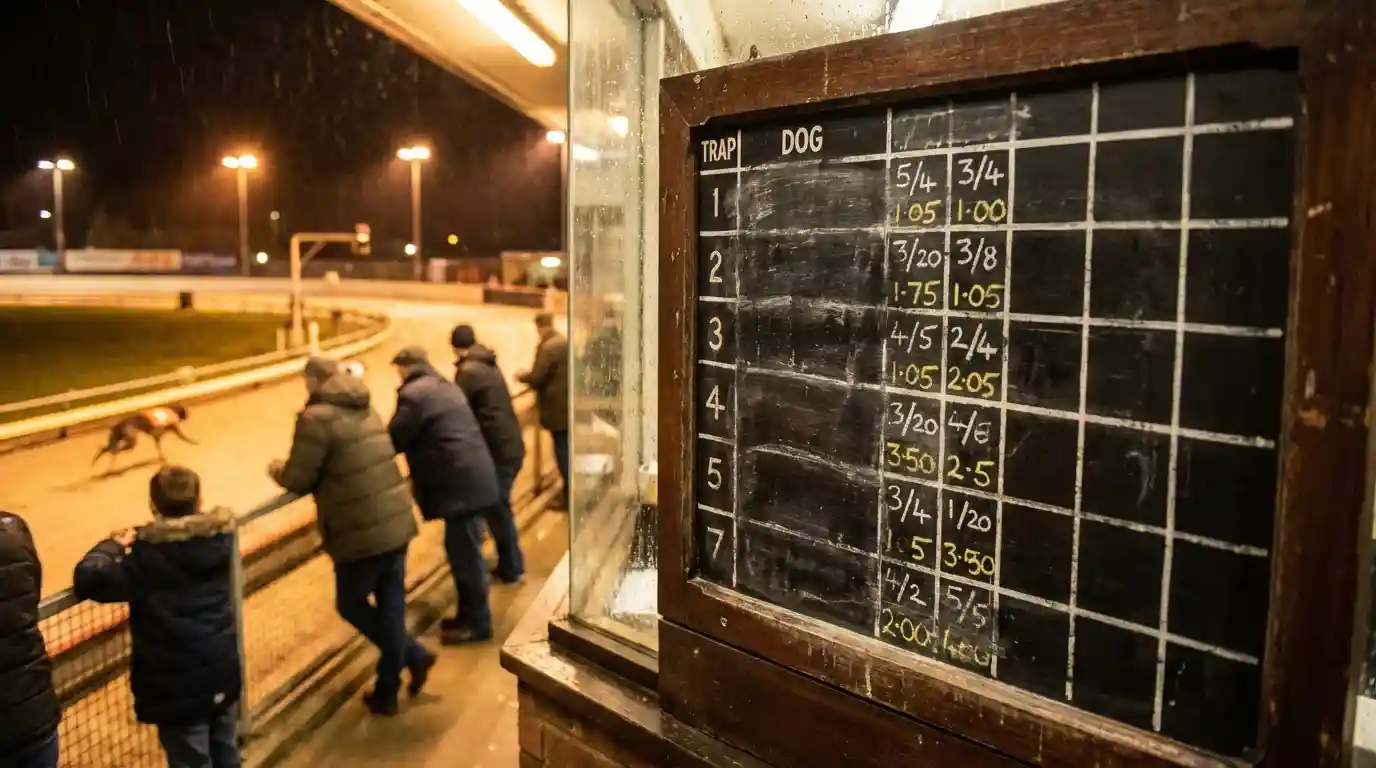
Market Pricing: Understanding SP and Early Prices
Bookmakers don’t predict winners — they set prices, and those prices are wrong more often than you’d think. This distinction is the foundation of profitable betting and the single most misunderstood concept among recreational punters. When a bookmaker prices a greyhound at 3/1, they’re not making a scientific claim that the dog has a 25% chance of winning. They’re setting a number that balances their book, attracts bets on both sides, and builds in a margin that ensures the house profits regardless of the outcome. The price reflects market dynamics, not objective truth.
In UK greyhound racing, odds are traditionally quoted in fractional format — 2/1, 5/2, 7/4 — which is a legacy of on-course bookmaking. Decimal odds (3.0, 3.5, 2.75) are increasingly common online and are simpler for mental arithmetic: multiply your stake by the decimal price to calculate the total return. Both formats convey the same information, just in different languages. What matters isn’t the format but what the numbers represent: an implied probability that you can compare against your own assessment to find an edge.
Greyhound markets are thinner than those for horse racing or football, and that’s where the opportunity lives. The odds on a Tuesday afternoon BAGS race are set by a small team — sometimes a single trader — and the price discovery process is less rigorous than in sports that attract millions in trading volume. Errors are more frequent, which means value is more available for the bettor who knows how to find it.
Fractional vs Decimal: Reading Greyhound Odds
4/1 means the bookmaker thinks this dog wins about 20% of the time — or rather, that’s what they want you to think. Fractional odds express the profit relative to the stake: 4/1 returns four pounds profit for every one pound staked, plus the stake itself. Decimal odds express the total return: 5.0 returns five pounds total for a one-pound stake (four profit, one stake back). The conversion is mechanical: add 1 to the fractional calculation. 3/1 becomes 4.0. 7/2 becomes 4.5. 5/4 becomes 2.25.
Where it gets useful is the conversion to implied probability, which tells you what the odds assume about the dog’s chance of winning. The formula is simple: divide 1 by the decimal odds. A dog at 4.0 (3/1) has an implied probability of 25%. A dog at 2.0 (evens) is priced at 50%. A dog at 10.0 (9/1) is given a 10% chance. These percentages are the bookmaker’s opinion expressed as numbers, and comparing them to your own opinion is the engine of value betting.
The overround is the bookmaker’s built-in margin. In a perfectly fair book, the implied probabilities of all six runners would add up to 100%. In reality, they add up to something higher — typically 115% to 125% in greyhound markets, depending on the bookmaker and the race. That excess is the overround, and it represents the house edge. A book with a 120% overround means the bookmaker is effectively charging a 20% premium across the market. Every runner’s odds are slightly shorter than a fair assessment would produce, which is how the bookmaker guarantees a profit over time.
Understanding the overround matters because it tells you the size of the barrier you need to overcome. If the overround is 120%, you need your selection process to outperform the market by more than that 20% margin to be profitable long-term. On exchanges like Betfair, where the overround is typically much lower (often 102% to 105%), the barrier is smaller, which is one reason serious bettors prefer exchange odds when liquidity allows. The format of the odds — fractional or decimal — is a matter of personal preference. The overround is a matter of profit and loss.
Starting Price vs Early Price
Take the early price when you see value; accept SP when the market hasn’t formed yet. The starting price (SP) is the official price of each runner at the moment the traps open. It’s determined by the on-course market (where one still exists) or by an industry-standard process based on the prices offered by major bookmakers. The early price is whatever the bookmaker quotes when they first open their market on a race, sometimes hours before the off.
Early prices on greyhound racing are common for BAGS meetings, where bookmakers publish odds in the morning for afternoon races. Taking an early price locks in the odds at that moment. If the dog shortens (its price decreases, meaning the market thinks it’s more likely to win), you’ve secured better value than if you’d waited. If it drifts (the price increases), you’ve paid over the odds. The decision to take early or wait for SP is a risk-reward judgment that depends on your confidence in the selection and your read of the market.
The case for taking early is strongest when you have an opinion that the market hasn’t yet absorbed. If you’ve identified a class-drop runner that you believe will shorten once other bettors notice the same angle, taking the morning price captures value before the crowd arrives. For short-priced favourites where you don’t expect much movement, early prices and SP tend to converge, and the decision matters less. For outsiders with a genuine chance, the early price can be significantly more generous than the SP if the dog attracts speculative money late in the day.
The case for SP is straightforward: you avoid overpaying if the dog drifts. If you’re not confident enough to commit at the morning price, SP lets the market mature and gives you the final settled number. The trade-off is that you lose the opportunity to capture any shortening that happens between morning and off time. Best Odds Guaranteed (BOG) offers from some bookmakers resolve this dilemma entirely by paying whichever is higher — your taken price or the SP — but not all bookmakers extend BOG to greyhound racing, and eligibility varies by meeting.
Reading Market Movement
A price that halves in 20 minutes isn’t random — someone knows something. Market movement in greyhound racing is less well-tracked than in horse racing, where dedicated services monitor every price change across dozens of bookmakers. But the movements that do occur are often more significant precisely because the market is thinner. When a greyhound’s price drops sharply from 5/1 to 5/2 in the run-up to a BAGS race, the volume of money required to cause that shift is smaller, which means fewer people need to act on information for it to show up in the price.
Steamers — dogs whose prices shorten dramatically — are the most watched movements. A steamer might indicate trainer confidence, a reliable kennel source reporting that the dog is in peak condition, or simply a well-informed punter who has spotted the same form angle you have and is acting on it. Not every steamer wins, but the strike rate of heavily backed dogs in greyhound racing is above the market average, which suggests that at least some of the money moving the price is informed.
Drifters — dogs whose prices lengthen — carry a different signal. A dog drifting from 2/1 to 4/1 is losing support, and the reasons can range from innocuous (the market was too short initially and is correcting) to significant (the parade revealed a flat or distracted dog, or connections have placed their money elsewhere). Not all drifters lose, but a sharp, late drift on a well-fancied dog is a cautionary signal worth respecting, especially if you were planning to back it.
Best Odds Guaranteed on Greyhounds
BOG on greyhounds is a pure edge — you get the best of both worlds with zero downside. Best Odds Guaranteed is a promotion offered by some UK bookmakers where you take an early price on a selection and, if the starting price is higher, the bookmaker pays out at the SP instead. You’re protected against drift (if the price shortens, you keep your better early price) and rewarded if the market moves in your favour after you’ve committed. It removes the SP-versus-early dilemma entirely.
The catch, such as it is, lies in availability. Not all bookmakers offer BOG on greyhound racing. Some restrict it to horse racing only. Others offer it on selected greyhound meetings — typically the higher-profile evening cards or open-race events — but exclude BAGS racing. A few extend it to all UK greyhound meetings without restriction. The specific terms change periodically, so checking which bookmakers currently offer BOG on the dogs is part of the prep work before you place a bet.
The impact on profit and loss is real and measurable. Over a season of betting, BOG payouts add up. If you take a price of 3/1 on a dog that goes off at 4/1, the BOG upgrade adds an extra unit of profit for every unit staked — free money on a selection you were going to back anyway. Across 100 bets, even if only 15 or 20 trigger the BOG upgrade (because the SP exceeds the taken price), those upgrades collectively can shift your annual return from marginal to comfortably positive. It is one of the few promotions in betting that offers genuine, no-strings value to the punter.
The practical advice is straightforward. If you’re betting on greyhound racing in the UK, use a bookmaker that offers BOG on the meetings you bet on. Take early prices when your analysis supports the selection. Let BOG handle the market risk. If two bookmakers are offering identical prices on the same dog but only one offers BOG, the choice is obvious. It is the easiest edge in greyhound betting to capture, and leaving it on the table is leaving money behind.
Exchange Odds vs Bookmaker Odds
Exchange odds strip out the bookmaker’s margin — but the liquidity trade-off is real, especially on BAGS racing. Betting exchanges like Betfair and Betdaq operate a fundamentally different model from traditional bookmakers. Instead of setting prices and accepting bets against their own book, exchanges match punters with opposing views: one backs a dog to win, another lays it to lose. The exchange takes a commission on winning bets (typically 2% to 5%, depending on your activity level on Betfair; other exchanges vary) but doesn’t build an overround into the prices. The result is that exchange odds are generally better — often significantly so — than the best bookmaker price.
On a typical greyhound race, a dog priced at 3/1 with a bookmaker might be available at 3.5 or 3.6 on Betfair’s back side. Over a hundred bets, that difference in price compounds into a material profit advantage for the exchange user. For serious bettors who track their return on investment, the move from bookmaker odds to exchange odds can shift an annual ROI from negative to positive without changing a single selection.
The limitation is liquidity. Exchange markets on greyhounds are thinner than on horse racing, football, or other major sports. Feature races and evening cards at popular tracks attract reasonable volumes, but a Tuesday morning BAGS race at a smaller venue might have only a few hundred pounds matched on the favourite and next to nothing on the outsiders. If your stake is larger than the available liquidity at your desired price, you either take a worse price, reduce your stake, or use a bookmaker instead. For most recreational bettors, this isn’t a problem — stakes of five to twenty pounds are easily accommodated on the exchange. For serious punters betting in larger units, liquidity becomes a genuine constraint.
The lay side of the exchange is where greyhound betting gets particularly interesting. You can lay a dog — bet against it winning — at odds you set yourself, and wait for a backer to match you. Lay betting on greyhounds is covered in depth in dedicated strategy material, but from an odds perspective, the key point is that the exchange gives you access to both sides of the market. You can back when the price is in your favour and lay when it isn’t, which doubles the number of betting opportunities available compared to using a traditional bookmaker alone.
Building a Value Betting Framework
Value betting isn’t a vague concept — it’s a repeatable process with a spreadsheet and a bit of nerve. The framework has four steps, each one building on the last, and none of them requires advanced mathematics. What they do require is discipline: the willingness to follow the process on every race you consider betting on, and the restraint to walk away when the numbers don’t support a bet.
Step one: price the race yourself. Before looking at the market, study the racecard and assign each of the six runners a percentage chance of winning. Use whatever analysis method you prefer — the four-pillar approach, calculated times, a combination of both — and arrive at a number for each dog. The dog you rate strongest might get 30%. A close rival, 25%. A couple of mid-range contenders, 18% and 14%. The remaining pair, 8% and 5%. The total should approximate 100%, though perfect precision isn’t necessary.
Step two: compare your prices to the market. Convert your percentages to decimal odds (divide 100 by the percentage: 30% becomes 3.33, 25% becomes 4.0). Now open the bookmaker’s prices or the exchange market. If you’ve priced a dog at 3.33 (roughly 7/3) and the bookmaker is offering 5.0 (4/1), there’s a substantial gap between your estimate and the market’s. According to your analysis, the dog should be shorter than the price available. That’s a potential value bet.
Step three: bet only when the edge exists. The discipline here is absolute. If your price matches the market — you’ve rated the dog at 4.0 and the bookmaker offers 4.0 — there’s no edge. Pass the race. If the market is shorter than your price — you rate the dog at 5.0 but the bookmaker offers 3.5 — the market thinks the dog has a better chance than you do. Pass again. Only bet when the market price exceeds your estimated fair price by a meaningful margin. How much margin counts as meaningful depends on your confidence in your pricing, but a general starting point is a 15% to 20% discrepancy.
Step four: track results over time. Flat staking — the same unit on every qualifying bet — is essential during the tracking phase because it isolates the quality of your selections from the impact of variable stake sizing. After 50 to 100 bets, review your return on investment. Positive ROI means your pricing is outperforming the market. Negative ROI means it isn’t — yet. Adjust your approach, refine your analysis of whichever pillar seems weakest, and continue. The framework is iterative: price, compare, bet, review, improve.
Tissue Pricing in Practice
The simplest way to build a tissue is to work through the card methodically. Start with the dog you rate highest and assign a percentage. Then compare each remaining runner to that benchmark. Is the second pick half as likely? Nearly as strong? The relative assessments are more important than the absolute numbers — you’re building a ranked probability model, not calculating to four decimal places.
A worked example helps. You’re looking at an A3 graded race over 480 metres. Dog A has the fastest recent CalcTm, a favourable trap draw, and clean in-running form — you rate it at 32%. Dog B is close on time but drawn on the wrong side — 22%. Dog C is dropping in grade and could improve — 18%. Dog D has patchy form but a fast first split — 13%. Dogs E and F are weak on all metrics — 10% and 5% respectively. Total: 100%. Convert to decimal odds: 3.13, 4.55, 5.56, 7.69, 10.0, and 20.0. Now compare to the bookmaker’s prices. If Dog C is available at 8.0 (12.5% implied) but you’ve rated it at 18%, the market is underestimating a class-drop runner by a significant margin. That’s your bet.
Tissue pricing becomes faster with practice. After a few weeks of doing it for every race you assess, the process takes five minutes per card and becomes semi-automatic. The spreadsheet does the conversion; you supply the percentages. The key is to complete your tissue before opening the market prices. If you look at the odds first, anchoring bias will contaminate your independent assessment, and the whole exercise becomes circular.
The Thin Market Advantage: Why Greyhound Odds Are Beatable
Nobody’s building AI models to price a Tuesday BAGS race at Sunderland — and that’s exactly why the value exists. Market efficiency is a function of attention. The more people study a market, the more accurate the prices become, and the harder it is for any individual to find an edge. Premier League football attracts billions in trading volume, dozens of modelling firms, and real-time data feeds. The odds on a Saturday 3pm kick-off are extremely tight. Finding value there requires expertise that most individuals cannot match.
Greyhound racing sits at the opposite end of the spectrum. UK greyhound markets are priced by a small number of bookmaker traders, receive limited media analysis, and attract a betting public that is largely casual. The BAGS programme alone runs thousands of races per month across multiple tracks, and the bookmaker simply cannot devote the analytical resources to each race that a dedicated punter with specialist track knowledge can. The result is a market where pricing errors — dogs too short, dogs too long — occur regularly.
The comparison to horse racing is instructive. A listed horse race at Ascot draws newspaper tipsters, podcasters, modelling services, and a deep exchange market that collectively pressure the odds toward accuracy. A Tuesday afternoon A5 race at Romford draws a bookmaker algorithm and a handful of punters. The information processing power applied to the greyhound race is orders of magnitude lower, and the odds reflect that gap. For the bettor willing to invest the time in form analysis and track study, greyhound markets offer an entry point into value betting that more scrutinised sports simply don’t.
This thin-market advantage does come with a ceiling. Because the markets are small, you can’t scale your stakes indefinitely — large bets will move prices or go unmatched on exchanges. But for recreational and semi-professional bettors working in units of five to fifty pounds, the market is deep enough to accommodate consistent betting and the inefficiencies are wide enough to exploit. It’s a sweet spot that the smart greyhound punter occupies with very little competition.
What the Odds Don’t Tell You: The Limits of Market Efficiency
The market knows a lot — but it doesn’t know what you’ve seen at the track this week. Odds are a consensus estimate assembled from the bookmaker’s model, the weight of money placed by punters, and, on exchanges, the back-and-lay activity of traders. As a consensus, they incorporate a wide range of information. But like any consensus, they’re backward-looking and incomplete. They reflect what the market knows, not what it doesn’t — and in greyhound racing, the gap between the two is larger than in almost any other betting medium.
Non-runners are the most obvious example. When a dog is withdrawn close to the off and a reserve steps in, the market has minutes to reprice the entire race. The reserve’s form may be from a different track at a different grade. Punters who can assess the reserve quickly — because they know the track, the trainer, or the dog from their own records — hold an information advantage that the market hasn’t digested yet. The prices in the immediate aftermath of a non-runner replacement are among the least efficient in all of greyhound betting.
Going changes mid-meeting are another blind spot. The official going is set before the first race, but a downpour at the third race can transform the surface for the fourth. The bookmaker may adjust slightly, but the full impact often shows up only in the race times. If you’re watching the meeting and notice that the last two winners both ran significantly slower than their CalcTm suggested they should, the going is probably heavier than declared. Dogs with a preference for slower conditions suddenly have an unpriced advantage.
Your edge, ultimately, doesn’t come from having better data than the bookmaker. It comes from interpreting the same data more carefully, supplementing it with live observation, and having the discipline to bet only when your interpretation diverges from the price. Odds are a starting point for the conversation between you and the market. The punter who treats them as the final word loses. The one who treats them as a question — is this price right? — is the one asking the only question that matters in betting.
