
Greyhound Forecast Bet Explained — Straight & Reverse
Best Greyhound Betting Sites – Bet on Greyhounds in 2026
Loading...
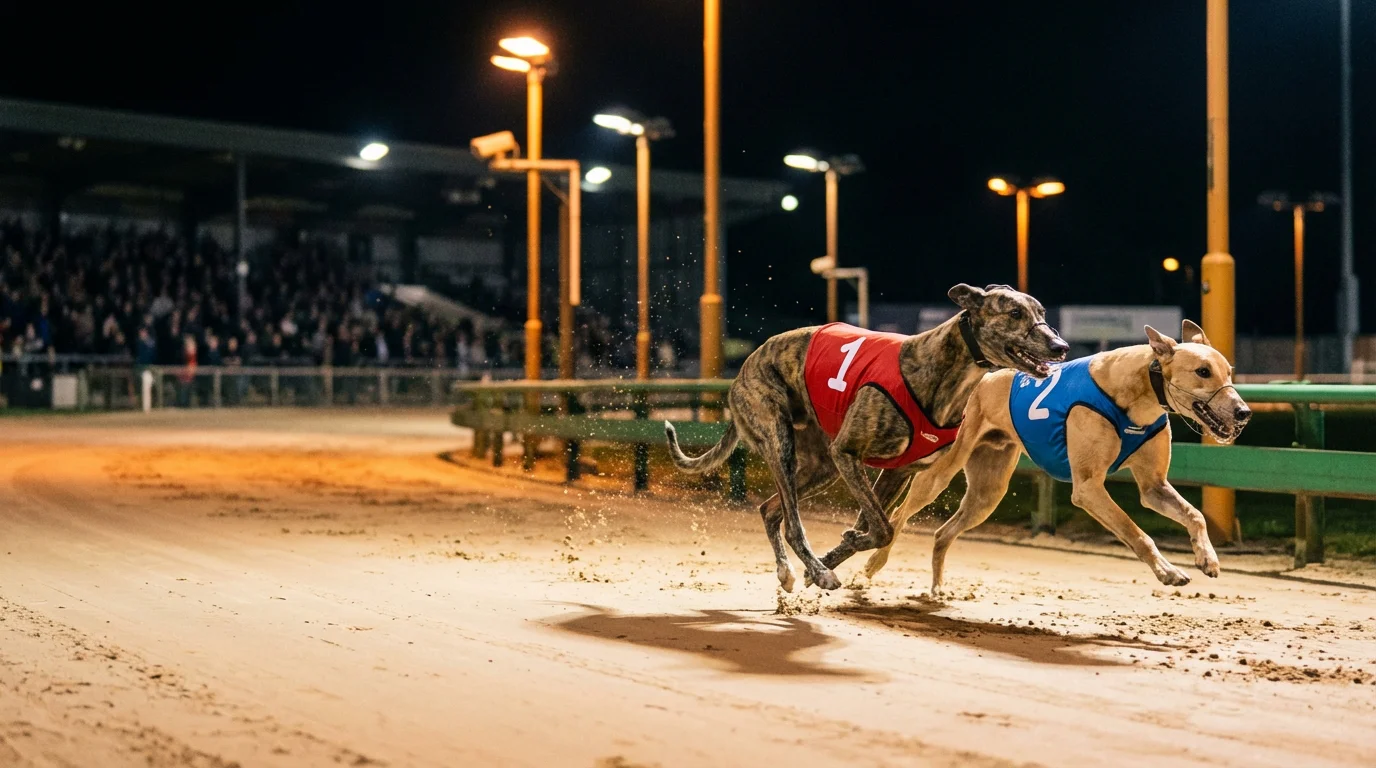
Two Dogs, One Question: Who’s First and Who’s Second?
Name the first two home in the right order — simpler to say than to do. That, in a sentence, is the forecast bet. Instead of backing a single greyhound to win, you’re predicting two finishing positions, and the reward for getting it right can dwarf anything a win single would return.
Forecast betting is one of the features that makes greyhound racing genuinely different from horse racing. With only six runners in the field, the permutations are manageable. There are just 30 possible first-and-second combinations in a six-dog race, compared to hundreds in a twelve-runner handicap at Cheltenham. That smaller number is precisely why forecasts in greyhound racing offer a realistic route to profit rather than a lottery ticket.
The bet comes in several forms — straight, reverse, and combination — and each carries a different cost, a different risk profile, and a different strategic logic. Understanding when to use which version is where the edge lives. Plenty of punters place forecasts as a punt; the sharp ones use them as a structured tool, reserved for races where they have a genuine opinion on the front two.
This guide breaks down every forecast variant, walks through the maths, and lays out a practical framework for deciding when a forecast bet is the smartest option on the card.
Straight Forecast: Exact Order Required
The straight forecast pays bigger because it demands precision. You name one dog to finish first and another to finish second, in that exact order. Reverse the two and you lose. It is the purest form of the forecast bet and, naturally, the one that returns the most.
Payouts on straight forecasts are determined by the Computer Straight Forecast dividend, commonly abbreviated to CSF. Unlike fixed-odds singles, the CSF is calculated after the race based on the starting prices of the first two finishers and the overall shape of the market. This means you cannot know the exact return before the traps open, though you can make a rough estimate if you know the approximate odds of both dogs.
Here is a simplified example. Suppose you back Trap 1 to win and Trap 4 to finish second, with a stake of five pounds. Trap 1 starts at 3/1 and Trap 4 at 5/1. The CSF dividend might land somewhere around 25/1 to 30/1, depending on the rest of the field’s prices. Your five-pound stake would return somewhere in the region of 130 to 155 pounds. Compare that to a simple win bet on Trap 1 at 3/1, which returns just 20 pounds. The difference is enormous — but so is the difficulty.
The CSF formula itself is proprietary and maintained by the industry, but the principle is straightforward: the less likely the combination, the higher the dividend. Two outsiders finishing first and second will generate a far bigger payout than two favourites. In greyhound racing, CSF dividends in open races regularly reach three figures from modest stakes, which is part of the bet’s appeal.
One important note: the straight forecast is available on every standard six-runner greyhound race in the UK. It is also offered on races with fewer runners if a dog is withdrawn, though the dividends naturally compress with a smaller field. Most bookmakers settle at CSF, though some offer fixed-odds forecasts — always check the terms, because the fixed price is frequently less generous than the CSF would have been.
Reverse Forecast: Either Order
Can’t split the front two? Reverse it — costs double, but covers both orders. The reverse forecast is exactly what it sounds like: two straight forecasts packaged into a single bet. You select two dogs, and you win if they finish first and second in either order.
The mechanics are simple. If you place a five-pound reverse forecast, you are actually placing two five-pound straight forecasts: Dog A first and Dog B second, plus Dog B first and Dog A second. Your total outlay is ten pounds. If either combination lands, the payout is the CSF dividend for the winning order multiplied by your unit stake.
This matters because CSF dividends are not symmetrical. Dog A winning with Dog B second might pay 22/1, while Dog B winning with Dog A second might only pay 14/1. The order of finish affects the market maths. With a reverse forecast, you are covered either way, but you will only collect on the order that actually occurs.
When does the reverse make sense? Primarily in races where you are confident about two dogs filling the first two places but cannot determine which one finishes ahead. This is more common than you might think. Two dogs might be clearly superior to the rest of the field on calculated times, but their trap draws or running styles make it genuinely unclear who crosses the line first. In those situations, the reverse forecast is a disciplined middle ground — more expensive than the straight, but far more likely to return something.
The trap to avoid: using reverse forecasts as a default because you cannot make a decision. If your analysis genuinely points to one dog being stronger, the straight forecast at half the cost is the better bet. The reverse is a tool for genuine uncertainty between two identified contenders, not a substitute for doing the work.
Combination Forecasts: Three or More Dogs
Each extra dog multiplies the combinations — and the stake. A combination forecast lets you select three or more dogs and covers every possible first-and-second permutation among them. The maths scales quickly, and understanding the cost structure is essential before placing one.
With three dogs selected, there are six possible forecast permutations. A five-pound combination forecast on three dogs therefore costs 30 pounds total. If any two of your three selections finish first and second, you collect the CSF dividend on that particular combination multiplied by your unit stake. The other five losing permutations are simply gone.
With four dogs, the permutations jump to twelve, so a five-pound combination forecast costs 60 pounds. Five dogs would produce twenty permutations and a 100-pound outlay at five pounds a line. Most experienced forecast punters stop at three or four selections; beyond that, the cost starts to undermine the return unless the CSF dividend is genuinely explosive.
The strategic case for combination forecasts is strongest in competitive races where the top two or three dogs on form are clear, but the rest of the field includes one live outsider that could sneak into second. Rather than trying to identify the exact finishing order from a tight group, you cover the realistic permutations and let the race sort itself out.
A practical example: you have studied the card at Monmore and identified Traps 1, 3, and 5 as the three dogs with the best calculated times. You are fairly sure one of them wins, but the second spot is wide open among the trio. A three-dog combination forecast at two pounds per line costs twelve pounds. If Trap 5 wins and Trap 1 finishes second, you collect the CSF on that specific outcome at your two-pound unit. The dividend might be 35/1, returning 72 pounds on your 12-pound stake. Not life-changing, but a healthy return for a well-reasoned play.
One word of caution: bookmakers will let you place combination forecasts on as many dogs as you like, including all six runners in a race. Covering all 30 permutations is technically possible, but mathematically absurd. If you are selecting more than four dogs for a combination forecast, you have essentially abandoned the analysis that makes the bet worthwhile in the first place.
When Forecasts Beat Win Bets
In a race with two clear standouts, a forecast can outperform a win bet every time. That is the core principle, and it is worth understanding why.
A win bet at 2/1 returns three pounds for every pound staked. Solid, predictable, no drama. But if that same 2/1 shot finishes first and a 4/1 dog runs second, the CSF dividend might land around 12/1 or higher. Suddenly the same level of analysis — identifying the winner — plus one additional correct opinion has tripled the return. The question is whether you had that second opinion in the first place.
Forecasts make the most sense in races with clear class separation. When two dogs are obviously a cut above the rest of the field on grades, calculated times, or recent form, the first-and-second puzzle becomes solvable. The win market in those races tends to be compressed (short-priced favourite, moderate second favourite), which makes the win bet stingy. The forecast market, by contrast, rewards you for the extra precision.
Conversely, forecasts are a poor choice in genuinely open races where any four of the six runners could realistically finish in the first two. In those situations, the CSF dividend may be attractive, but the strike rate drops so sharply that the long-term return on investment collapses. You are effectively guessing, and dressing up a guess in a forecast slip does not make it analysis.
A useful rule of thumb: if you can narrow the first two places down to two or three dogs with genuine conviction, forecasts are likely to offer better long-term value than win singles. If your field assessment produces four or more realistic contenders for the first two spots, the win bet — or no bet at all — is the sharper choice.
Track conditions also play a role. BAGS meetings at smaller venues often produce more predictable results because the grading is tighter and the fields less competitive. These cards are natural forecast territory. Evening open-race cards at venues like Hove or Nottingham, where the quality is higher and the fields more closely matched, tend to favour win betting or more selective use of forecasts.
The Forecast Mindset: Thinking in Pairs
Stop thinking about who wins — start thinking about who finishes first and second. That shift in perspective is what separates a casual punter who occasionally dabbles in forecasts from someone who uses them as a structured part of their betting approach.
Most people study a racecard looking for the winner. They pick a dog, check its form, maybe glance at the trap draw, and place a win bet. The forecast punter does something different. They study the card looking for pairs — which two dogs are most likely to fill the first two positions, regardless of exact order? That mental shift changes the way you read form, assess trap draws, and evaluate early speed. It forces you to think about the race as an event with multiple runners, not just a spotlight on one dog.
The practical benefit of this approach is that it sometimes reveals value where the win market shows none. A race with a 4/6 favourite might look unappealing for a win bet, but if the second-best dog is clearly identifiable at 5/1, the straight forecast of the favourite over that second dog could return handsomely relative to the stake. The win market is priced tight; the forecast dividend is not.
Discipline still matters. The best forecast punters keep records of their forecast bets separately from their win bets, tracking strike rate and ROI by bet type. Over time, the data reveals which race types suit forecast betting and which do not — and that information is worth far more than any individual payout.
Forecast betting in greyhound racing is not exotic, not risky, and not complicated. It is a logical extension of good analysis, applied to a six-dog field where the maths actually works in your favour. The only thing it demands that a win bet does not is a second opinion. If your homework gives you one, use it.