
Greyhound Racing Abbreviations — Full Glossary of Terms
Best Greyhound Betting Sites – Bet on Greyhounds in 2026
Loading...
The Language of the Dogs: Why Abbreviations Matter
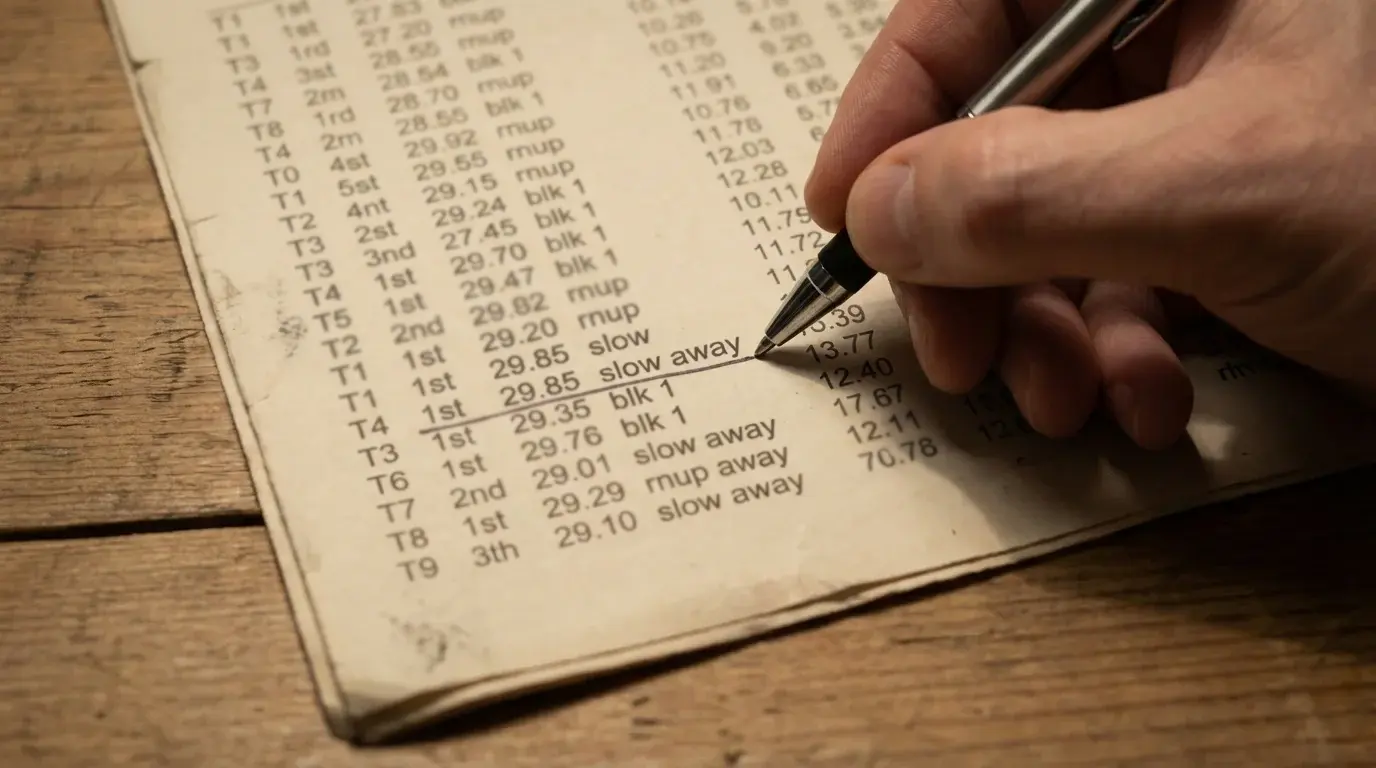
Greyhound racing has its own shorthand, and if you cannot read it, you are flying blind. The racecard, the form guide, the in-running comments, and the betting market all rely on abbreviations that compress critical information into a few characters. A newcomer looking at a form line sees an impenetrable string of letters and numbers. An experienced punter sees a complete narrative of how a dog ran, where it was at each point of the race, and what prevented it — or helped it — to finish where it did.
This glossary is a reference guide to every significant abbreviation you will encounter in UK greyhound racing: racecard codes, in-running remarks, betting terms, and grade designations. Bookmark it, refer back to it, and treat it as the dictionary you need until the language becomes instinctive.
Racecard Codes and Form Symbols
The racecard is where your analysis begins, and its codes form the foundation of greyhound literacy. Every element on the card has a meaning, and the abbreviations follow a consistent system across all GBGB tracks.
Trap numbers run from 1 to 6, with each number corresponding to a coloured racing jacket: 1 is red, 2 is blue, 3 is white, 4 is black, 5 is orange, and 6 is black-and-white stripes. The reserve runner, if called upon to replace a withdrawn dog, is denoted by R or Res and wears a distinctive jacket.
Form figures show the dog’s finishing position in each of its recent races, reading from left to right with the most recent run last. A form line of 3-1-2-4-1-2 tells you the dog finished third, then won, then second, and so on across its last six starts. A dash or hyphen between figures separates individual runs. The letter F in the form line indicates a fall, which is rare in flat racing but can occur. The letter O indicates the dog ran in an open race rather than a graded event.
Running-style classifications appear alongside each dog’s name on the racecard. R indicates a railer — a dog that prefers to run on the inside rail. W denotes a wide runner that drifts to the outside. M marks a middle tracker that runs between the rail and the outside. These designations are assigned by the racing manager and influence the trap draw allocation.
Weight is shown in kilograms to one decimal place. A reading of 31.4 means the dog weighed 31.4 kilograms at the pre-race weigh-in. Wt or Wgt may appear as the column header. The one-kilogram rule means any dog varying by more than 1kg from its last racing weight must be withdrawn.
Time entries on the racecard include the winning time (WinTm), the split time or sectional time to the first timing point (commonly shown as a decimal, e.g. 4.21), and the calculated time (CalcTm) which adjusts the raw time for going conditions. An asterisk next to a CalcTm indicates it is the best calculated time the dog has recorded over that distance at that track.
Going allowance appears as a positive or negative number — for example, +10, -5, or N for normal. This figure, measured in hundredths of a second, is applied to the raw time to produce the calculated time. A positive allowance indicates fast going; a negative allowance indicates slow conditions.
Distance beaten is shown in lengths. A notation of 1.5 means the dog finished one and a half lengths behind the dog in front. Nk means a neck, Sh Hd is a short head, and Hd is a head. Dist indicates the dog was beaten by a considerable distance, typically ten or more lengths.
In-Running Remarks Decoded
In-running remarks are the most information-dense abbreviations on the racecard. They describe what happened to each dog during the race, and interpreting them correctly can completely change your assessment of a form figure.
EPace means the dog showed early pace and was prominent in the early stages of the race, typically leading or disputing the lead to the first bend. SAw indicates slow away — the dog was slow out of the traps and lost ground at the start. QAw is the opposite: quick away, meaning the dog broke sharply.
Positional abbreviations use numbers to indicate bend positions. Ld1 means the dog led at the first bend. Ld2 means it led at the second. Ld3 and Ld4 follow the same pattern. LdRnIn means the dog led on the run-in, the final straight to the finishing line. Disp means disputed the lead, typically with another dog.
Interference remarks are critical for form assessment. Crd means crowded — the dog was squeezed for room between other runners. Bmp indicates bumped — physical contact with another dog. Baulk or Blk means baulked — the dog’s path was blocked, forcing it to check or change direction. CkBmp is a combination: checked and bumped simultaneously. These remarks explain poor finishing positions that were not the dog’s fault, and identifying them is fundamental to reading form accurately.
Movement remarks describe how the dog travelled during the race. RnOn means ran on — the dog finished strongly in the closing stages. Fin means it finished well. RnUp means it ran up behind the leaders without quite getting past them. Fdd indicates faded — the dog weakened in the closing stages after being prominent earlier. Styd means stayed on, maintaining its effort without making dramatic progress.
Wider running descriptions include VW for very wide — the dog ran significantly wider than its natural line, covering extra ground. MsdBk means missed the break — similar to SAw but sometimes implying a more dramatic loss at the start. FcdTCk means forced to check — the dog had to decelerate or change direction because of interference, and this remark is particularly important because it indicates the run was compromised by events beyond the dog’s control.
Track-specific remarks occasionally appear. Rls means rails — the dog raced on the inside rail throughout. Mid or Mdl indicates it raced in the middle of the track. Wide or Wd means it raced on the outside. These are not judgments about running style but descriptions of where the dog actually ran during that specific race, which may differ from its classified running style if it was drawn out of position.
Betting Terms Every Greyhound Punter Should Know
The betting side of greyhound racing carries its own set of abbreviations, and understanding them is essential for navigating markets, reading bet slips, and making sense of commentary and analysis.
SP stands for Starting Price — the official odds at the moment the race begins. If you do not take a fixed price before the off, your bet is settled at SP. BOG is Best Odds Guaranteed — a bookmaker feature that pays the higher of your taken price or the SP if your selection wins. E/W means each way — two bets in one, combining a win bet and a place bet.
CSF is the Computer Straight Forecast, the dividend calculated after the race that determines the payout for straight forecast bets. CT is the Computer Tricast, the equivalent dividend for tricast bets. Both are derived from the starting prices of the placed dogs and the overall market structure. FC is a shorthand for forecast, and TC for tricast.
Accumulator terminology includes Dbl for double (two selections), Trbl for treble (three), and 4-Fld, 5-Fld and so on for four-fold, five-fold accumulators. A patent is a full-cover bet on three selections: three singles, three doubles, and one treble — seven bets in total. A Yankee covers four selections with 11 bets: six doubles, four trebles, and one four-fold. These full-cover bet types are used in greyhound racing just as they are in horse racing and football.
NAP is the tipster’s strongest selection of the day — the one bet they are most confident about. NB is Next Best, the second-strongest selection. These terms appear frequently in greyhound tipping columns and racing previews.
Lay, Back, and Trade are exchange-specific terms. A back bet is a traditional bet on a dog to win. A lay bet is a bet against a dog winning. Trading involves backing at a higher price and laying at a lower price, or vice versa, to lock in a profit regardless of the outcome. These terms are relevant on Betfair, Betdaq, and other betting exchanges.
ROI stands for return on investment — the percentage profit or loss relative to total stakes. LSP is level stakes profit — the profit or loss generated from betting the same flat stake on every selection. Both are standard performance metrics used to assess betting records and tipster performance. A positive ROI or LSP over a meaningful sample size indicates a profitable approach; a negative figure indicates the opposite.
Grades and Race Categories
Grade designations tell you the class of the race and the level of the dogs competing. The standard grading system uses a letter-number format: A1 is the highest graded level at most tracks, descending through A2, A3, and so on down to A10 or A11 depending on the venue. The A denotes the standard distance for that track.
Other distance prefixes include S for sprint, D for middle distance, and H for hurdles, though hurdle racing is extremely rare in the modern UK schedule. The prefix letters combine with numbers in the same way: S1 is the top sprint grade, D3 is the third middle-distance grade, and so on.
OR stands for Open Race — an event where the racing manager selects dogs by merit from across the grade spectrum rather than grouping them by grade band. P or Pup indicates a puppy race for dogs under a specified age, typically around two years. IT or ID denotes inter-track races where dogs from different venues compete. These category codes appear in the race header on the card and immediately tell you what type of competition you are assessing.
Fluent in Greyhound: The Shorthand That Sharpens Your Edge
Every abbreviation in this glossary exists because greyhound racing packs a large volume of information into a compact format. The racecard has limited space, and the sport has developed a precise shorthand over decades to ensure that nothing important is omitted. Learning that shorthand is not optional if you intend to bet seriously — it is the literacy requirement for the sport.
You will not memorise every abbreviation in one reading. That is fine. The most frequently encountered codes — the in-running remarks, the form figures, the key betting terms — will become instinctive within a few weeks of active racecard study. The less common abbreviations can be looked up as they appear. The important thing is knowing that every abbreviation on the card carries information, and that ignoring any of it means making decisions with incomplete data.
Keep this glossary to hand for your next few meetings. Within a month, you will not need it. The language of greyhound racing will have become your own.