
Greyhound Track Conditions — How Going Affects Race Results
Best Greyhound Betting Sites – Bet on Greyhounds in 2026
Loading...
The Surface Beneath Their Feet: Why Going Matters
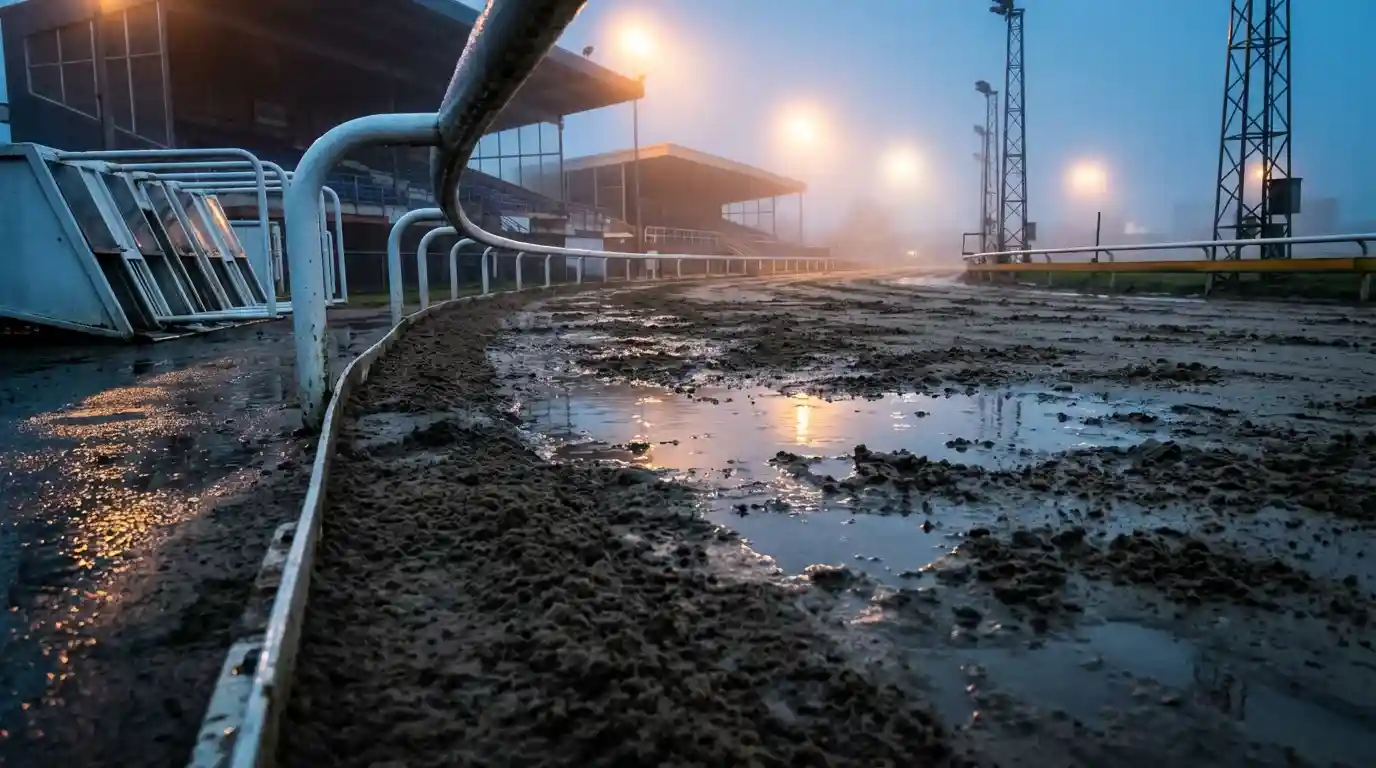
Every greyhound track in the UK runs on sand, and every grain of that sand behaves differently depending on how wet, dry, compacted, or freshly prepared it is. The going — the official assessment of the track surface condition — is the invisible variable that connects weather, track preparation, and race results. Two identical dogs running on the same track a week apart can produce times that differ by several lengths, purely because the surface changed.
In horse racing, the going is headline news. Punters check it before every meeting, and the impact on betting is immediate and obvious. In greyhound racing, the going receives far less attention from the casual market, despite having a comparable effect on outcomes. This asymmetry creates opportunity. The going data is publicly available, it directly affects calculated times, and yet most punters barely glance at it. Those who do pay attention have an informational edge that costs nothing to acquire.
This guide explains how the going system works, how fast and slow surfaces affect different types of dog, what role the weather and track staff play, and how to incorporate going data into your betting analysis.
The Going System in Greyhound Racing
The going in greyhound racing is expressed as a numerical adjustment, measured in hundredths of a second, that is applied to the standard time for a given distance at a given track. Unlike horse racing, where the going is described in words — good, soft, heavy — greyhound going is quantitative. A going allowance of +10 means the track is running 10 hundredths of a second faster than normal. An allowance of -15 means it is running 15 hundredths slower. N indicates normal conditions with no adjustment.
The allowance is determined before each meeting by the track management, typically by running a trial greyhound over the standard distance and comparing its time to the track’s baseline for that distance. The baseline represents the average time in normal conditions, and the difference between the trial run and the baseline produces the going figure for the meeting. This allowance is then applied uniformly to all races at that distance throughout the evening.
The going figure appears on the racecard alongside each dog’s previous runs, allowing punters to see the conditions under which each run was recorded. More importantly, the going figure is used to calculate the calculated time — the adjusted time that strips out the surface variable and allows fair comparison between runs on different nights.
At most UK tracks, the going allowance tends to range from around -20 (very slow, heavy surface after rain) to +20 (very fast, dry and firm surface). The extreme ends of this range are rare, and most meetings fall within -10 to +10. When the going moves significantly in either direction — say, from +5 at the last meeting to -15 tonight after a day of rain — the impact on race times is dramatic, and dogs that have not previously raced in those conditions are a genuine unknown.
One point that catches out beginners: the going can change during a meeting. A track that starts the evening on normal going can deteriorate if rain falls during the card. Conversely, a track that was heavy early in the day may dry out during racing if the weather clears. The going figure is set before the first race and may not be updated during the meeting, which means the later races might effectively be run on a different surface from the early ones. Watching the race times as the meeting progresses gives you a live indicator of whether the going is shifting.
Fast Ground vs Slow Ground: How Dogs Respond
Not every greyhound handles every surface equally, and this is where going data becomes a genuine betting tool. Some dogs are natural fast-ground performers: they need a firm, dry surface to express their speed and their action becomes laboured on heavier going. Others thrive on a slower surface, where their stamina and strength compensate for a lack of raw pace.
Fast ground favours front-runners and early-speed dogs. A firm, dry surface allows for quicker times out of the traps and sharper acceleration through the first bend. Dogs with explosive early pace benefit disproportionately because the surface supports their fastest stride. On slow ground, the advantage shifts towards dogs with stamina and a strong finishing kick. The heavier surface saps early speed, which means that dogs that lead at the first bend on fast ground may not lead on slow ground — the pace dynamic of the entire race changes.
Identifying a dog’s going preference requires looking at its previous form in different conditions. Check the going allowance on the racecard for each of the dog’s last six runs and compare the calculated times. A dog that posts its best CalcTm on nights with a positive going allowance (fast) and its worst on negative nights (slow) is a fast-ground specialist. The reverse pattern indicates a slow-ground preference.
Not all dogs have a strong preference. Some are genuinely versatile and perform consistently regardless of conditions. These are valuable selections because they remove one variable from your assessment — you do not need to worry about the going for these dogs, which simplifies the form reading. The dogs that do have a preference, however, are where the value lives, because the market often prices them based on overall form without adjusting for the going conditions of tonight’s card.
Sprint races are more affected by going than staying races. Over shorter distances, the margins are tighter and the surface has a proportionally greater impact on the raw time. A change in going that adds or removes two tenths of a second from a sprint time can be the difference between winning and finishing third. Over a longer trip, the same time difference is absorbed more easily by the overall distance.
Weather, Water and the Track Staff’s Influence
The going is ultimately determined by the interaction between weather and track preparation. Rain slows the surface by increasing the moisture content of the sand. Sun and wind dry it out and speed it up. Frost, though less common at meeting times due to floodlit evening schedules, can create an unpredictable surface that is fast in some areas and slow in others.
Track staff actively manage the surface before and during meetings. Watering — deliberately adding moisture to the sand — is standard practice at most venues, particularly in dry weather, to maintain a consistent and safe running surface. The amount and timing of watering directly affects the going. A track that was watered heavily before racing will run slower than one that was left dry. Some venues water between races during the meeting if the surface begins to break up or become uneven.
Rolling and harrowing — compacting or turning over the sand — also affect the going. A freshly harrowed surface is typically looser and slower than a compacted one. The track staff’s preparation routine varies by venue and by the conditions on the day, and while punters cannot control these decisions, being aware that they happen — and that they affect times — adds context to the raw numbers on the racecard.
For the home bettor, the simplest way to gauge the likely going is to check the weather forecast for the track’s location in the hours before the meeting. Heavy rain during the afternoon will almost certainly produce slow going by the evening. A dry, warm day will produce fast conditions. Cross-reference this with the going allowance when it is published, and you have a reasonable picture of the surface before the first race.
One seasonal pattern worth noting: winter meetings in the UK tend to produce consistently slower going than summer meetings, for obvious reasons. Dogs with slow-ground form from previous winters are more likely to handle December and January conditions than dogs that raced exclusively through a dry summer. Building a seasonal going profile for each dog you follow adds another layer to your form analysis.
Using Going Data in Your Betting
Incorporating going data into your betting process requires one additional step in your pre-race analysis: comparing tonight’s going to the going conditions under which each dog produced its recent form. If tonight’s track is significantly different from the conditions of a dog’s last few runs, the form may not translate.
A practical example. A dog shows strong form figures — 1-2-1-1-3-2 — from its last six races. Impressive. But on closer inspection, five of those six runs came on fast going with a positive allowance. Tonight’s meeting has a going allowance of -12 after a wet afternoon. The dog has one run on similar slow going in its record, and it finished fifth. That single slow-ground run carries more weight for tonight’s assessment than the five good runs on fast ground combined.
The calculated time system partially accounts for the going through its built-in adjustment, but it is not a complete solution. CalcTm normalises the time to a standard benchmark, which is useful for comparison. But it does not tell you how a dog felt on the surface — whether it was struggling for grip, finding the going too heavy to express its speed, or conversely relishing the softer conditions. The CalcTm shows the adjusted output; the going preference analysis tells you why that output was what it was.
Building a simple going log for the dogs you regularly follow takes minimal effort and pays significant dividends. Note the going allowance for each run alongside the CalcTm and the finishing position. After ten or fifteen runs, the pattern emerges: this dog runs its best on +5 to +15. On -10 or worse, it consistently underperforms. That knowledge, applied on a wet February evening when the going is heavy and the market has not adjusted, is a tangible edge.
Going data also interacts with trap bias. A track that favours inside runners on fast going may become more neutral on slow going, because the pace advantage of the rail is reduced when the surface is heavy and the early speed differential between traps narrows. Checking whether your track’s trap bias holds across different going conditions prevents you from applying a bias assumption that is only valid in specific circumstances.
The Ground Tells a Story — If You’re Listening
Track conditions are the most overlooked variable in greyhound betting. The form is on the racecard, the trap draw is in the programme, and the odds are on the screen. The going is published too, but it sits quietly in the background, rarely discussed and even more rarely factored into casual betting decisions.
That neglect is your advantage. Every meeting, the going creates a surface that favours some dogs and disadvantages others. The market prices dogs based on their overall form profile, not their going-specific record. The punter who checks the weather, reads the going figure, and cross-references it against each dog’s surface preferences is making a more informed decision than the vast majority of the market — and in betting, better information, consistently applied, is the definition of edge.
Check the going before you check the odds. The surface is the stage on which the race is run, and the dogs that suit the stage have a head start before the traps even open.