Greyhound Trap Draw Explained — How Box Numbers Affect Results
Best Greyhound Betting Sites – Bet on Greyhounds in 2026
Loading...
Before the Race Starts: Why the Box Number Matters
The race is half-decided before the hare even moves. That is not hyperbole — it is the logical outcome of six dogs leaving starting boxes arranged in a line and funnelling into the first bend within a few strides. The box each dog starts from, known as the trap draw, determines how much clear track it has, whether it needs to cross other dogs to reach its preferred running line, and how likely it is to get through the first bend without interference.
In most sports, starting position is a minor factor. In greyhound racing, it is a major one. A dog’s trap number dictates its route into the first turn, and the first turn is where most races are effectively decided. The dog that arrives there in front with a clear run will win more often than any other single variable predicts. Everything else — form, fitness, class — gets filtered through the reality of what happens in those first few explosive seconds after the traps open.
Understanding how dogs are allocated to traps, what the trap colours mean, and how bias varies from track to track is foundational knowledge. Without it, you are reading half a racecard and making decisions with incomplete information. The trap draw is not a detail to note in passing. It is, alongside form and class, one of the three pillars of greyhound selection.
This guide explains the system from the ground up: how seeding works, what each trap colour represents, where to find bias data, and how to spot the running-line conflicts that turn well-fancied dogs into beaten favourites.
How Dogs Are Seeded: Railers, Middles & Wides
Seeding isn’t random — it’s the racing manager’s attempt to give every dog a fair run. Every GBGB track employs a racing manager whose job includes allocating dogs to traps based on their running style. The aim is to minimise first-bend interference by placing each dog where its natural running line causes the least disruption to the rest of the field.
Each greyhound is classified by running style into one of three categories. A railer hugs the inside rail and wants the shortest route around the bends. A wide runner drifts to the outside and needs room on the turns. A middle tracker runs between the two, neither seeking the rail nor swinging wide. These classifications are noted on the racecard with the letters R, M, and W.
In graded races, which make up the bulk of a typical meeting card, the racing manager seeds dogs under the guidelines set out in GBGB rules. Railers are placed towards the inside traps — traps 1 and 2 in most cases. Wide runners go to the outside — traps 5 and 6. Middle trackers fill the centre. The exact allocation depends on the specific dogs entered and their recent running patterns, but the general principle holds across all GBGB venues.
Open races operate under different draw rules. Because open events attract dogs from various grades and sometimes from different tracks, the racing manager has more discretion in how the draw is constructed. The goal remains the same — reduce first-bend crowding — but the greater variation in the quality and running styles of the entries makes the task more complex. Open-race draws are often considered less predictable than graded-race draws, and experienced punters factor this into their assessment.
Where the system breaks down is at the margins. A dog classified as a middle tracker might have been reclassified from a railer after a couple of wide-running efforts, but its instinct under race pressure could revert to railing. Similarly, a dog new to a track might be seeded based on its running style at its previous venue, which may not translate directly. These classification gaps create the running-line conflicts that produce unexpected results — and, for the alert bettor, unexpected value.
Trap Colours & Jacket System
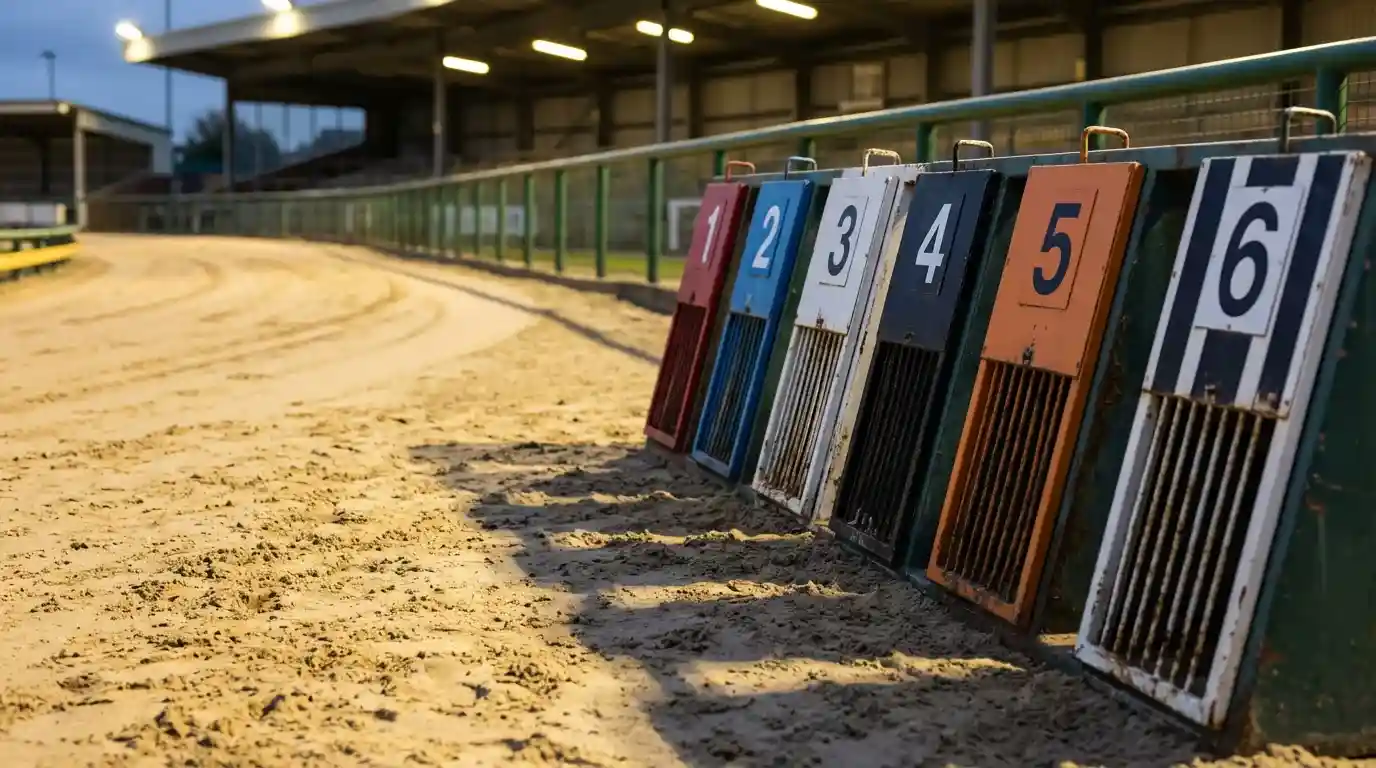
Red, blue, white, black, orange, stripes — learn the sequence once and you’ll never forget. Every greyhound wears a coloured racing jacket corresponding to its trap number, and the system is standardised across all UK tracks. Trap 1 is red, trap 2 is blue, trap 3 is white, trap 4 is black, trap 5 is orange, and trap 6 wears black-and-white stripes.
The jackets serve a purely practical purpose: they allow spectators, judges, and camera operators to identify each dog during the race. At speeds above 40 miles per hour and with six dogs bunched together through the bends, jacket colours are often the only way to tell who is where. If a reserve runner replaces a withdrawn dog, it wears a jacket with a distinctive reserve design, typically featuring a broad horizontal stripe, to distinguish it from the original field.
For punters, the colour system is mainly a visual shorthand. When someone at the track says “the blue dog looked good in the parade” or “red got crowded at the second bend,” they are referring to the trap number, not the dog’s actual coat colour. This language becomes second nature quickly, and most regular racegoers think in jacket colours rather than trap numbers during the race itself.
One practical note: at some tracks, the striped jacket for trap 6 can be difficult to distinguish from the black jacket of trap 4 under artificial lighting, particularly on older camera feeds. If you are betting from home and watching a stream rather than attending in person, pay close attention to the running positions in the early stages — misidentifying a dog mid-race can lead to poor in-play decisions or incorrect post-race analysis of what actually happened.
Track-Specific Trap Bias
Trap bias is geometry — tight bends favour inside runners, sweeping bends favour outside. That is the foundational principle, and everything else follows from the physical layout of the individual track.
A track with tight, sharply angled bends gives a natural advantage to dogs drawn on the inside. The inside rail is simply a shorter route around each turn, and a dog that hugs the rail covers less ground over the full distance of the race. At a venue like Romford, which has notoriously tight bends, trap 1 historically produces a higher win percentage than trap 6 by a meaningful margin. The physics of the turn make it so.
Wider, more galloping tracks reduce or even eliminate this inside bias. At Towcester, for instance, the sweeping bends and generous track width mean that outside runners have more room to maintain their stride without being forced into traffic. The trap bias at wider venues tends to be flatter, with no single trap dominating the win statistics over a large sample of races.
The important point is that trap bias is not uniform. It varies not just between tracks but between distances at the same track. A venue might show a strong trap 1 bias over the sprint distance but a more balanced picture over the standard trip, because the sprint involves fewer bends and the starting position relative to the first turn is different. Checking bias data by both track and distance is essential if you want the numbers to mean anything.
Where do you find this data? Several free statistical services publish trap win percentages by venue and distance, updated regularly. The GBGB’s own results archive provides the raw material if you prefer to compile your own numbers. Most serious punters track bias over rolling 12-month periods, which is long enough to smooth out short-term noise but recent enough to capture any changes caused by track maintenance, resanding, or alterations to the running rail.
Seasonal variation adds another wrinkle. Sand tracks race differently in wet and dry conditions. A track that favours trap 1 in summer, when the sand is dry and fast, might become more neutral in winter when the surface is heavier and wetter. Rain changes the going, the going changes the pace dynamics, and the pace dynamics can shift the trap bias. This is why static bias tables are a starting point, not a conclusion. Your own observations, updated week by week, are worth more than any published table that has not been refreshed since last season.
Running Line Conflicts: When the Draw Creates Chaos
Put a railer in trap 5 and a wide runner in trap 2 — someone’s getting bumped at the first bend. Running-line conflicts are the most underappreciated factor in greyhound race analysis, and they happen more often than you might expect.
A conflict occurs when two or more dogs need to cross each other’s paths to reach their preferred running position. The classic scenario: a dog classified as a railer is drawn in trap 4 or 5. Its instinct from the moment the traps open is to cut towards the inside rail. Meanwhile, the dogs drawn inside it are breaking forward in a straight line or drifting slightly outward. The railer cutting in creates traffic, and traffic means checking, bumping, and lost ground for everyone involved.
The reverse conflict is equally damaging. A wide runner drawn in trap 1 or 2 needs to move outward from the inside position. As it drifts towards the centre and outside, it blocks the natural path of dogs breaking from the middle traps. The result is the same: crowding, interference, and a first bend that looks more like a demolition derby than a race.
Identifying these conflicts before the race requires two pieces of information: each dog’s running style classification and its trap number. Look at the racecard and map out who is going where. If a railer is drawn outside a wide runner, their paths will cross. If two railers are drawn next to each other, both will head for the rail, and the one drawn further outside will have to yield or cause interference. If a wide runner is drawn between two middle trackers, it may drift outward and create a gap that collapses as the middle trackers close the space.
The practical betting angle is straightforward. Dogs involved in likely conflicts are worse bets than their form suggests. The dog’s ability has not changed, but its probability of getting a clean run at the first bend has dropped significantly. Conversely, a dog that has a clear running line — a railer in trap 1 with no other railers drawn alongside, for example — has a better chance of a trouble-free passage than a dog of equal ability in a more congested position. The draw does not change a dog’s speed. It changes the odds of that speed being fully expressed.
The Invisible Starting Line
The trap draw is the hidden variable that separates informed bettors from everyone else. It is easy to overlook because it does not appear in the form figures and it does not feature in most casual discussions about a race. People talk about a dog’s recent wins, its time, its trainer. They rarely talk about whether it was drawn on the right side of the track.
That oversight is your opportunity. Every race, the trap draw creates advantages and disadvantages that the market does not always fully price in. A dog with strong form but a poor draw is often still backed at short odds because the form is visible and the draw conflict is not. A dog with average form but a perfect draw — a railer in trap 1 on a track with strong inside bias — is frequently underrated because its form figures do not jump off the page.
Learn the bias at your regular tracks. Study the seeding patterns. Spot the conflicts. The trap draw is not the whole story, but it is the chapter most punters skip — and skipping it costs them money they never see leaving.