Live Greyhound Betting — In-Play Strategies for the Dogs
Best Greyhound Betting Sites – Bet on Greyhounds in 2026
Loading...
The Live Edge: Information That Arrives After the Market Opens
The racecard is published hours before the first race. The betting market opens shortly after. But the most valuable information in greyhound racing often arrives in the final minutes before the traps open — during the parade, through late market movements, and in the form of non-runner announcements that reshape the entire race.
Live greyhound betting is not primarily about in-play wagering during the race itself, which lasts barely 30 seconds and offers limited scope for meaningful in-running decisions. It is about the pre-race window: the period between the market opening and the traps opening, when new information becomes available that the early market has not priced in. This window is where alert punters find opportunities that form-only analysis cannot provide.
This guide covers the practical aspects of live greyhound betting: what markets are available, how to extract intelligence from the parade, how to interpret late market movements, and how to react when a non-runner transforms the shape of a race.
In-Play Markets: What’s Available and What’s Not
True in-play betting on greyhound racing is severely limited by the nature of the sport. A race lasts around 25 to 30 seconds. The action is concentrated into a small window, and the outcome is often decided at the first bend — roughly five seconds in. There is no half-time, no second set, no strategic timeout. The race happens, and then it is over.
Some betting exchanges and bookmakers do offer in-play markets on greyhound racing, but the reality is that these markets are thin, the odds shift instantly once the traps open, and the latency between your screen and the live action means you are almost always behind. By the time you see a dog leading at the first bend and try to back it, the price has already collapsed. In-play greyhound betting as a deliberate strategy is impractical for most punters.
What is practical — and where the live edge genuinely exists — is the pre-race market. The period from roughly 15 minutes before a race to the moment the traps open is when the market is most active and most responsive to new information. Prices shift as money comes in, non-runners are announced, and the on-course bookmakers adjust their boards based on what they see in the parade ring. This pre-race phase is the real arena for live greyhound betting.
On betting exchanges, the pre-race market is particularly dynamic. Prices can move significantly in the final two or three minutes before the off as large stakes arrive or informed money targets a specific dog. Watching these movements — and understanding what drives them — is a skill that adds a layer of intelligence on top of your form analysis.
Parade Watching: The Pre-Race Intelligence Window
At evening meetings and some higher-profile daytime cards, the dogs are paraded in front of the stands before each race. For the on-course punter, this is a live intelligence-gathering opportunity. For the home bettor watching via a bookmaker’s stream, it is the next best thing.
What to look for in the parade is straightforward, though interpreting it requires experience. A dog that walks calmly on the lead, moves freely without stiffness, and appears alert but relaxed is presenting well. A dog that is pulling hard, lunging towards other dogs, or appearing visibly agitated may expend nervous energy before the race even starts. Neither of these observations is a guarantee of anything, but over hundreds of parades, the patterns become meaningful.
Physical condition is the other parade indicator. A dog that looks lean and muscular is typically in racing trim. A dog carrying visible extra weight around the midsection or hindquarters may be underprepared, particularly if it is returning from a break. Coat condition, although harder to assess on a screen, also provides clues — a glossy, tight coat usually indicates good health, while a dull or loose coat can suggest the dog is not at peak fitness.
The practical application of parade watching is as a final filter, not a primary selection tool. You have already done your form analysis, assessed the trap draw, and identified your fancied selections. The parade confirms or raises concerns. If your top-rated dog looks agitated or stiff in the parade, it might be worth reducing your stake or switching to a secondary selection. If a dog you had written off looks exceptional in the parade, it warrants a second look at the form to see if you missed something.
On-course punters have one advantage that cannot be replicated through a screen: they can hear the commentary from the kennel staff and observe the dogs at closer range. Some trainers give subtle signals through their body language — confidence, concern, indifference — that the camera does not capture. This is one of the last remaining informational edges that trackside attendance provides over remote betting.
Late Market Moves and What They Mean
A price that halves in 20 minutes is not random — someone knows something. Late market movements in greyhound racing are often sharper and more informative than in horse racing because the markets are thinner and it takes less money to move the price. A single large bet from an informed punter can shift a dog’s odds from 4/1 to 2/1 in minutes.
Steamers — dogs whose price shortens significantly in the final minutes before a race — are the most common type of late market move. A steamer typically indicates confident money coming in, often from sources close to the kennels or from punters with track-specific knowledge. Not every steamer wins, but the signal is worth noting. A dog that has shortened from 5/1 to 5/2 in the last ten minutes is attracting money for a reason.
Drifters — dogs whose price lengthens in the market — carry the opposite signal. A dog that was 2/1 in the morning and drifts to 7/2 by race time is losing support. This can happen because other dogs in the race are attracting more money, because a non-runner has changed the dynamic, or because on-course intelligence suggests the dog is not at its best. A drift does not mean the dog cannot win, but it indicates that the people closest to the information are looking elsewhere.
The challenge for the remote bettor is distinguishing genuine informed moves from random market fluctuation. A useful rule: significant moves on larger exchange markets are more likely to be informed than identical moves on thin bookmaker markets. If a dog shortens by a full point on Betfair with thousands of pounds matched, that is a meaningful signal. If the same dog shortens by a point at a single bookmaker where only a few hundred pounds has been traded, it might just be one punter’s preference moving a thin book.
Reacting to market moves requires speed and confidence. If your pre-race analysis already identified a dog as a strong selection and it starts steaming in the market, backing it quickly before the price compresses further locks in value. Conversely, if your fancied dog begins to drift for no obvious reason, caution is warranted — the market may know something your form analysis could not capture.
Non-Runner Impact: When the Race Changes Shape
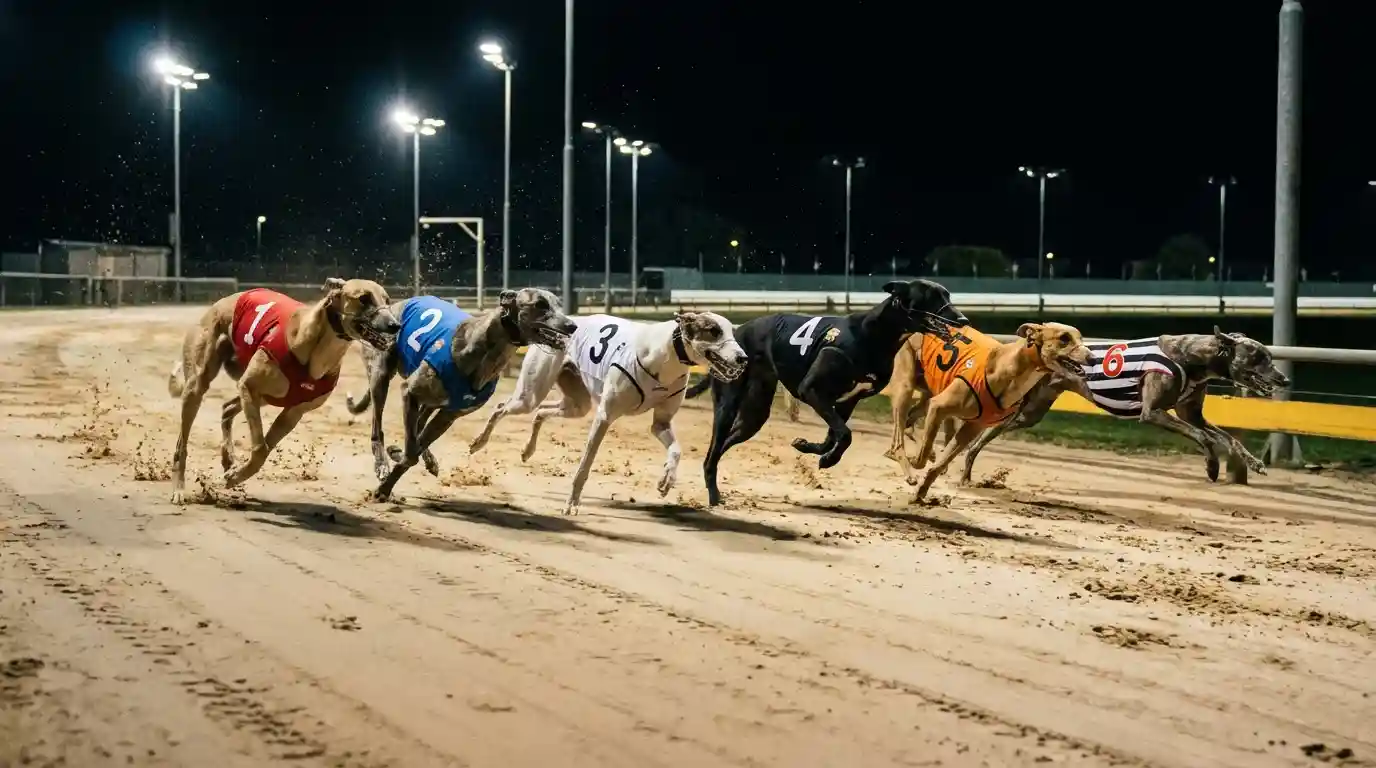
A non-runner in a six-dog greyhound race is not a minor event. It removes one-sixth of the field and fundamentally changes the dynamics of the race — the trap draw, the running-line conflicts, and the probability calculations all shift when a dog is withdrawn.
Non-runners can be announced at any point from the morning of the race up to minutes before the traps open. Early withdrawals, typically due to injury, illness, or a weight discrepancy under the one-kilogram rule, give the market time to adjust. Late withdrawals — sometimes announced during the parade or at the traps themselves — catch the market off guard and can create sharp, immediate value opportunities.
The key question when a non-runner is declared is: which remaining dogs benefit from the withdrawal? The answer almost always comes down to the trap draw and running lines. If the withdrawn dog was a wide runner in trap 6, the dog in trap 5 suddenly has less traffic on its outside and a cleaner run into the first bend. If the withdrawn dog was the fastest early-pace dog in the race, the second-fastest breaker now becomes the likely leader at the first bend, and its probability of winning increases significantly.
Conversely, some dogs benefit less from a non-runner than you might expect. If the withdrawn dog was in trap 3 and a reserve runner replaces it, the race dynamic barely changes — the replacement is still in the same trap, still has a running style, and still occupies the same space in the first-bend traffic. The key is whether the replacement is materially weaker or stronger than the withdrawn dog, and whether the withdrawal creates a void in the pace makeup of the race.
Betting rules vary by bookmaker when a non-runner is involved. If you have already placed a bet on the withdrawn dog, most bookmakers refund the stake. If you have a forecast or tricast involving the withdrawn dog, the bet is typically voided. If you have an accumulator with the withdrawn dog as one leg, that leg is usually treated as a non-runner and the acca rolls on with the remaining legs at adjusted odds. Always check the specific terms of your bookmaker, because the settlement rules for non-runners in forecast and tricast markets can differ.
The sharp punter treats a non-runner announcement as an invitation to re-assess. Pull out your analysis, reconsider the race without the withdrawn dog, and decide whether the remaining field creates a betting opportunity that was not there before. Late non-runners, in particular, create market inefficiency because most punters have already placed their bets and the market has not fully adjusted. Being quick to react — with analysis, not panic — is one of the most reliable edges in live greyhound betting.
Eyes on the Track, Not Just the Screen
The racecard is history. The market is the present. And the parade, the late market movements, and the non-runner announcements are the live intelligence that the racecard cannot provide. The best greyhound punters combine all three: they arrive at the market with a form-based opinion, they test that opinion against the live information, and they adjust accordingly.
This does not mean abandoning your pre-race analysis at the first sign of a market move. It means treating the pre-race window as an additional data source, one that either confirms your position or raises enough doubt to warrant a change. If the parade looks wrong, the market is drifting, and a non-runner has changed the dynamics — all pointing in the same direction — the smart money listens. If the live information is ambiguous or contradicts itself, the form analysis stands.
Live greyhound betting is not about reacting to every signal. It is about knowing which signals matter and having the discipline to act on them quickly, calmly, and within the framework of a broader strategy.